aster.cloud aster.cloud
  • /
  • Platforms
    • Public Cloud
    • On-Premise
    • Hybrid Cloud
    • Data
  • Architecture
    • Design
    • Solutions
    • Enterprise
  • Engineering
    • Automation
    • Software Engineering
    • Project Management
    • DevOps
  • Programming
    • Learning
  • Tools
  • About
  • /
  • Platforms
    • Public Cloud
    • On-Premise
    • Hybrid Cloud
    • Data
  • Architecture
    • Design
    • Solutions
    • Enterprise
  • Engineering
    • Automation
    • Software Engineering
    • Project Management
    • DevOps
  • Programming
    • Learning
  • Tools
  • About
aster.cloud aster.cloud
  • /
  • Platforms
    • Public Cloud
    • On-Premise
    • Hybrid Cloud
    • Data
  • Architecture
    • Design
    • Solutions
    • Enterprise
  • Engineering
    • Automation
    • Software Engineering
    • Project Management
    • DevOps
  • Programming
    • Learning
  • Tools
  • About
  • Software Engineering

Upgrading Android Attestation: Remote Provisioning

  • aster.cloud
  • March 28, 2022
  • 3 minute read

Attestation as a feature has been mandated since Android 8.0. As releases have come and gone, it has increasingly become more and more central to trust for a variety of features and services such as SafetyNet, Identity Credential, Digital Car Key, and a variety of third party libraries. In light of this, it is time we revisited our attestation infrastructure to tighten up the security of our trust chain and increase the recoverability of device trust in the event of known vulnerabilities.

Starting in Android 12.0, we will be providing an option to replace in-factory private key provisioning with a combination of in-factory public key extraction and over-the-air certificate provisioning with short-lived certificates. This scheme will be mandated in Android 13.0. We call this new scheme Remote Key Provisioning.


Partner with aster.cloud
for your next big idea.
Let us know here.


From our partners:

CITI.IO :: Business. Institutions. Society. Global Political Economy.
CYBERPOGO.COM :: For the Arts, Sciences, and Technology.
DADAHACKS.COM :: Parenting For The Rest Of Us.
ZEDISTA.COM :: Entertainment. Sports. Culture. Escape.
TAKUMAKU.COM :: For The Hearth And Home.
ASTER.CLOUD :: From The Cloud And Beyond.
LIWAIWAI.COM :: Intelligence, Inside and Outside.
GLOBALCLOUDPLATFORMS.COM :: For The World's Computing Needs.
FIREGULAMAN.COM :: For The Fire In The Belly Of The Coder.
ASTERCASTER.COM :: Supra Astra. Beyond The Stars.
BARTDAY.COM :: Prosperity For Everyone.


Who This Impacts?

OEMs/ODMs

Device manufacturers will no longer be provisioning attestation private keys directly to devices in the factory, removing the burden of having to manage secrets in the factory for attestation.

Relying Parties, Potentially

Described further down below, the format, algorithms, and length of the certificate chain in an attestation will be changing. If a relying party has set up their certificate validation code to very strictly fit the legacy certificate chain structure, then this code will need to be updated.


Why Change?

The two primary motivating factors for changing the way we provision attestation certificates to devices are to allow devices to be recovered post-compromise and to tighten up the attestation supply chain. In today’s attestation scheme, if a device model is found to be compromised in a way that affects the trust signal of an attestation, or if a key is leaked through some mechanism, the key must be revoked. Due to the increasing number of services that rely on the attestation key signal, this can have a large impact on the consumer whose device is affected.

Read More  AlphaGenome: AI for better understanding the genome

This change allows us to stop provisioning to devices that are on known-compromised software, and remove the potential for unintentional key leakage. This will go a long way in reducing the potential for service disruption to the user.
Google Servers Image


How Does This Work?

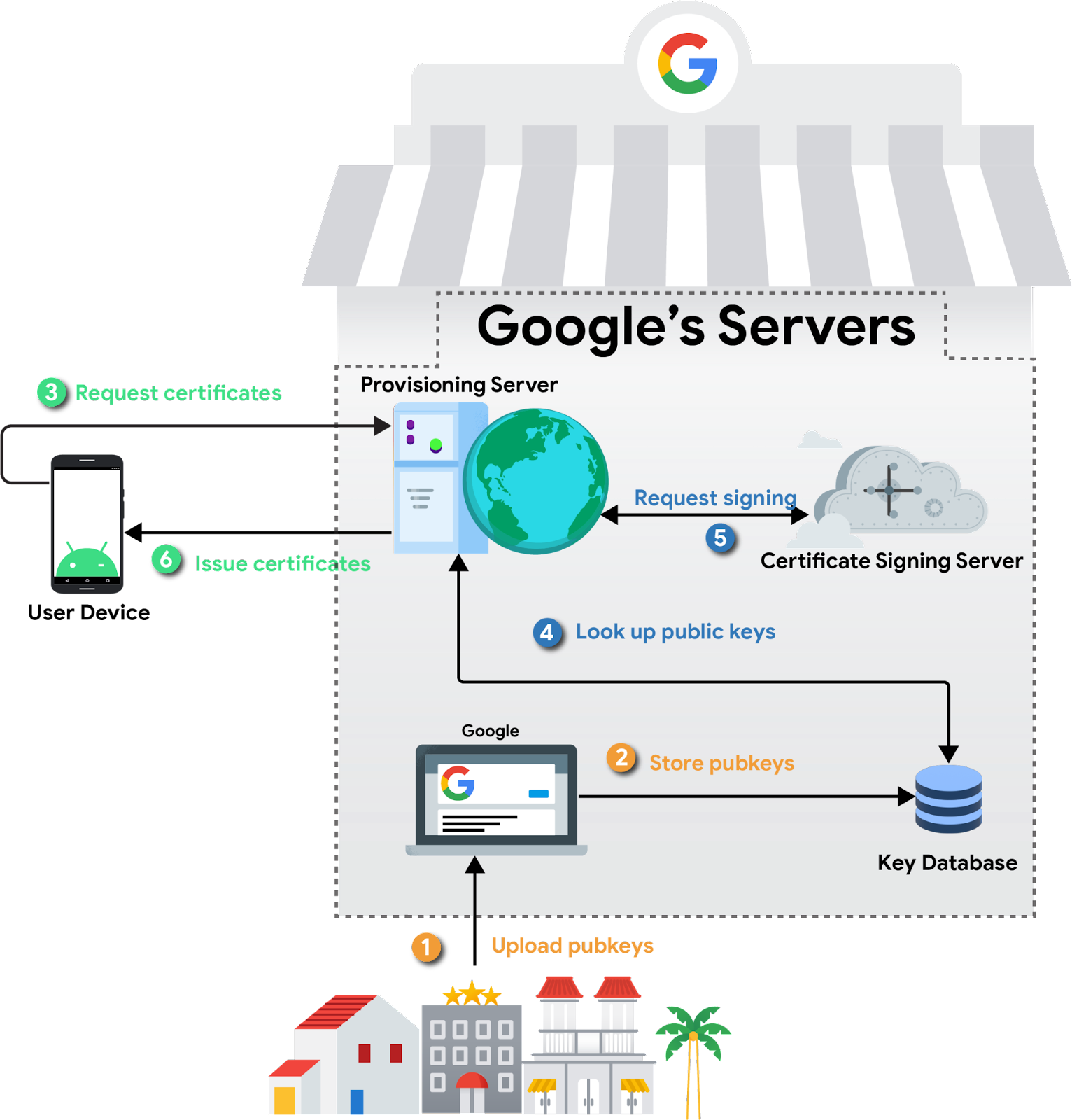
A unique, static keypair is generated by each device, and the public portion of this keypair is extracted by the OEM in their factory. These public keys are then uploaded to Google servers, where they serve as the basis of trust for provisioning later. The private key never leaves the secure environment in which it is generated.

When a device is unboxed and connected to the internet, it will generate a certificate signing request for keys it has generated, signing it with the private key that corresponds to the public key collected in the factory. Backend servers will verify the authenticity of the request and then sign the public keys, returning the certificate chains. Keystore will then store these certificate chains, assigning them to apps whenever an attestation is requested.

This flow will happen regularly upon expiration of the certificates or exhaustion of the current key supply. The scheme is privacy preserving in that each application receives a different attestation key, and the keys themselves are rotated regularly. Additionally, Google backend servers are segmented such that the server which verifies the device’s public key does not see the attached attestation keys. This means it is not possible for Google to correlate attestation keys back to a particular device that requested them.


What is Changing from a Technical Standpoint?

End users won’t notice any changes. Developers that leverage attestation will want to watch out for the following changes:

  • Certificate Chain Structure
    • Due to the nature of our new online provisioning infrastructure, the chain length is longer than it was previously, and is subject to change.
  • Root of Trust
    • The root of trust will eventually be updated from the current RSA key to an ECDSA key.
  • RSA Attestation Deprecation
    • All keys generated and attested by KeyMint will be signed with an ECDSA key and corresponding certificate chain. Previously, asymmetric keys were signed by their corresponding algorithm.
  • Short-Lived Certificates and Attestation Keys
    • Certificates provisioned to devices will generally be valid for up to two months before they expire and are rotated.
Read More  Introducing Google Gen AI .NET SDK


By Max Bires, Software Engineer
Source Android


For enquiries, product placements, sponsorships, and collaborations, connect with us at [email protected]. We'd love to hear from you!

Our humans need coffee too! Your support is highly appreciated, thank you!

aster.cloud

Related Topics
  • Android
  • Android 12.0
  • google
You May Also Like
View Post
  • Software Engineering

Embedded Swift Improvements Coming in Swift 6.3

  • November 22, 2025
Visual Studio Code
View Post
  • Software Engineering

Visual Studio 2026 is here: faster, smarter, and a hit with early adopters

  • November 12, 2025
View Post
  • Software Engineering

Introducing Google Gen AI .NET SDK

  • October 24, 2025
View Post
  • Software Engineering

Julia 1.12 Highlights

  • October 13, 2025
View Post
  • Engineering
  • Software Engineering

Development gets better with Age

  • October 9, 2025
View Post
  • Software Engineering

The Growth of the Swift Server Ecosystem

  • September 27, 2025
men with computer website information and chat bubbles vector illustration
View Post
  • Software
  • Software Engineering

What is an ISV (independent software vendor)?

  • August 27, 2025
aster-cloud-erp-bill_of_materials_2
View Post
  • Software
  • Software Engineering

What is an SBOM (software bill of materials)?

  • July 2, 2025

Stay Connected!
LATEST
  • 1
    Expectations vs. Reality: The AI We Thought We’d Have in 10 Years
    • June 19, 2026
  • digital-nomad-freelancer-worker-2151205464 2
    One paperwork problem – Get your Digital Nomad Visa employment documents fast from UK, EU or Singapore
    • June 16, 2026
  • 3
    Samsung Art Store Brings Art Basel to Homes Worldwide With New Curated Collection
    • June 15, 2026
  • 4
    You Do Not Need to Invest in the IPO of SpaceX, Anthropic, and OpenAI
    • June 10, 2026
  • 5
    The consequences of relying on AI for accurate news
    • June 10, 2026
  • 6
    Connecting AI agents with unstructured data using Google Cloud Storage MCP Servers
    • June 10, 2026
  • 7
    WWDC26: Apple unveils next generation of Apple Intelligence, Siri AI, powerful parental controls, and an expansive set of software improvements
    • June 8, 2026
  • 8
    IBM and Google Cloud Announce Strategic Partnership to Scale AI with Human Expertise and AI‑Powered Delivery
    • June 4, 2026
  • Data center 9
    Data Sovereignty in Spain. It’s Not Just About the Law, It’s About Efficiency
    • June 3, 2026
  • 10
    Ink vs Pixels. What you miss versus what you are actually missing.
    • June 1, 2026
about
Hello World!

We are aster.cloud. We’re created by programmers for programmers.

Our site aims to provide guides, programming tips, reviews, and interesting materials for tech people and those who want to learn in general.

We would like to hear from you.

If you have any feedback, enquiries, or sponsorship request, kindly reach out to us at:

[email protected]
Most Popular
  • 1
    Banks race to patch new cyber vulnerabilities, and other cybersecurity news
    • May 25, 2026
  • pope-leo-xiv-cq5dam-1500.844 2
    Pope Leo XIV to Publish First Encyclical on Artificial Intelligence and Human Dignity on 25 May
    • May 22, 2026
  • 3
    Portfolio to Clients, and is Strengthened by Ongoing Project Glasswing Work
    • May 20, 2026
  • reMarkable Paper Pure 4
    Everything The reMarkable Paper Pure Actually Does
    • May 14, 2026
  • 5
    Scaling cloud and AI: Microsoft Azure’s commitment to Europe’s digital future
    • May 11, 2026
  • /
  • Technology
  • Tools
  • About
  • Contact Us

Input your search keywords and press Enter.