aster.cloud aster.cloud
  • /
  • Platforms
    • Public Cloud
    • On-Premise
    • Hybrid Cloud
    • Data
  • Architecture
    • Design
    • Solutions
    • Enterprise
  • Engineering
    • Automation
    • Software Engineering
    • Project Management
    • DevOps
  • Programming
    • Learning
  • Tools
  • About
  • /
  • Platforms
    • Public Cloud
    • On-Premise
    • Hybrid Cloud
    • Data
  • Architecture
    • Design
    • Solutions
    • Enterprise
  • Engineering
    • Automation
    • Software Engineering
    • Project Management
    • DevOps
  • Programming
    • Learning
  • Tools
  • About
aster.cloud aster.cloud
  • /
  • Platforms
    • Public Cloud
    • On-Premise
    • Hybrid Cloud
    • Data
  • Architecture
    • Design
    • Solutions
    • Enterprise
  • Engineering
    • Automation
    • Software Engineering
    • Project Management
    • DevOps
  • Programming
    • Learning
  • Tools
  • About
  • Engineering

Reduce Scaling Costs By Up To 50% In Cloud Spanner With Doubled Provisioned Storage

  • aster.cloud
  • April 20, 2022
  • 3 minute read

Cloud Spanner is Google Cloud’s fully managed relational database that offers unlimited scale, strong consistency across regions, and high availability up to 99.999%. Spanner handles more than two billion requests per second. Spanner is trusted by customers in financial services, retail, gaming and many other industries. We are excited to announce that Spanner has doubled the storage capacity for all Cloud Spanner instances to help customers optimize the compute cost of storage intensive workloads.  For example, Cloud Spanner instances with 1 node (1,000 processing units) can now have 4TB storage capacity instead of 2TB (8TB per 2 nodes, 12TB for 3 nodes, and so on)

Customers building applications such as transactional ledger or inventory management on Spanner have higher storage requirements in comparison to compute requirements. As they scale storage, they end up over-provisioning compute to support the storage, incurring additional cost.  We have increased the storage per node so that customers can better align their costs with their usage.


Partner with aster.cloud
for your next big idea.
Let us know here.


From our partners:

CITI.IO :: Business. Institutions. Society. Global Political Economy.
CYBERPOGO.COM :: For the Arts, Sciences, and Technology.
DADAHACKS.COM :: Parenting For The Rest Of Us.
ZEDISTA.COM :: Entertainment. Sports. Culture. Escape.
TAKUMAKU.COM :: For The Hearth And Home.
ASTER.CLOUD :: From The Cloud And Beyond.
LIWAIWAI.COM :: Intelligence, Inside and Outside.
GLOBALCLOUDPLATFORMS.COM :: For The World's Computing Needs.
FIREGULAMAN.COM :: For The Fire In The Belly Of The Coder.
ASTERCASTER.COM :: Supra Astra. Beyond The Stars.
BARTDAY.COM :: Prosperity For Everyone.

With this launch, current users are automatically upgraded to the increased storage capacity without the need to opt-in or create new instances. This feature does not change storage pricing or the way storage is billed in Spanner. Users still pay for the actual storage their database uses, regardless of the storage capacity Spanner provisions. To view the storage capacity available for your Spanner instance, visit Cloud Console, select Spanner and click on any instance. You should now see the upgraded capacity of 4TB per node.
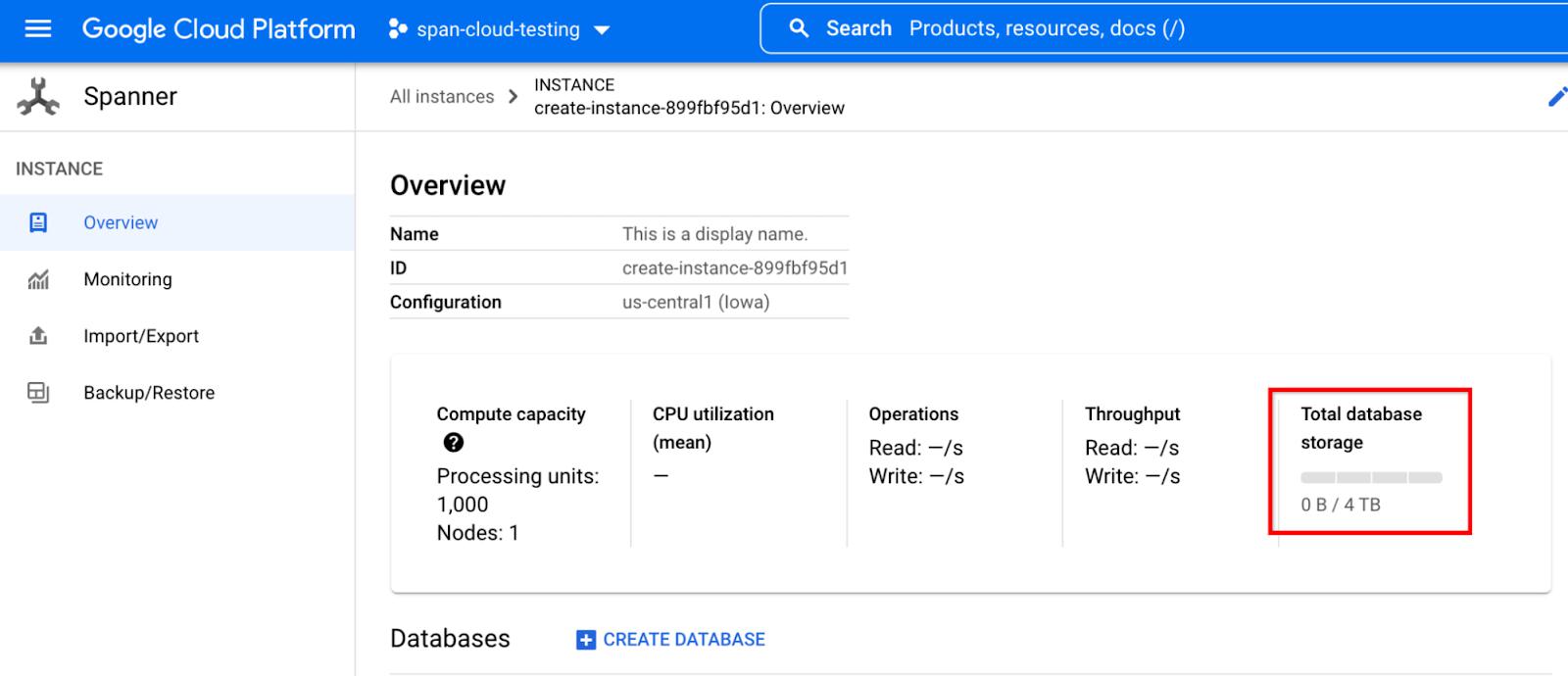
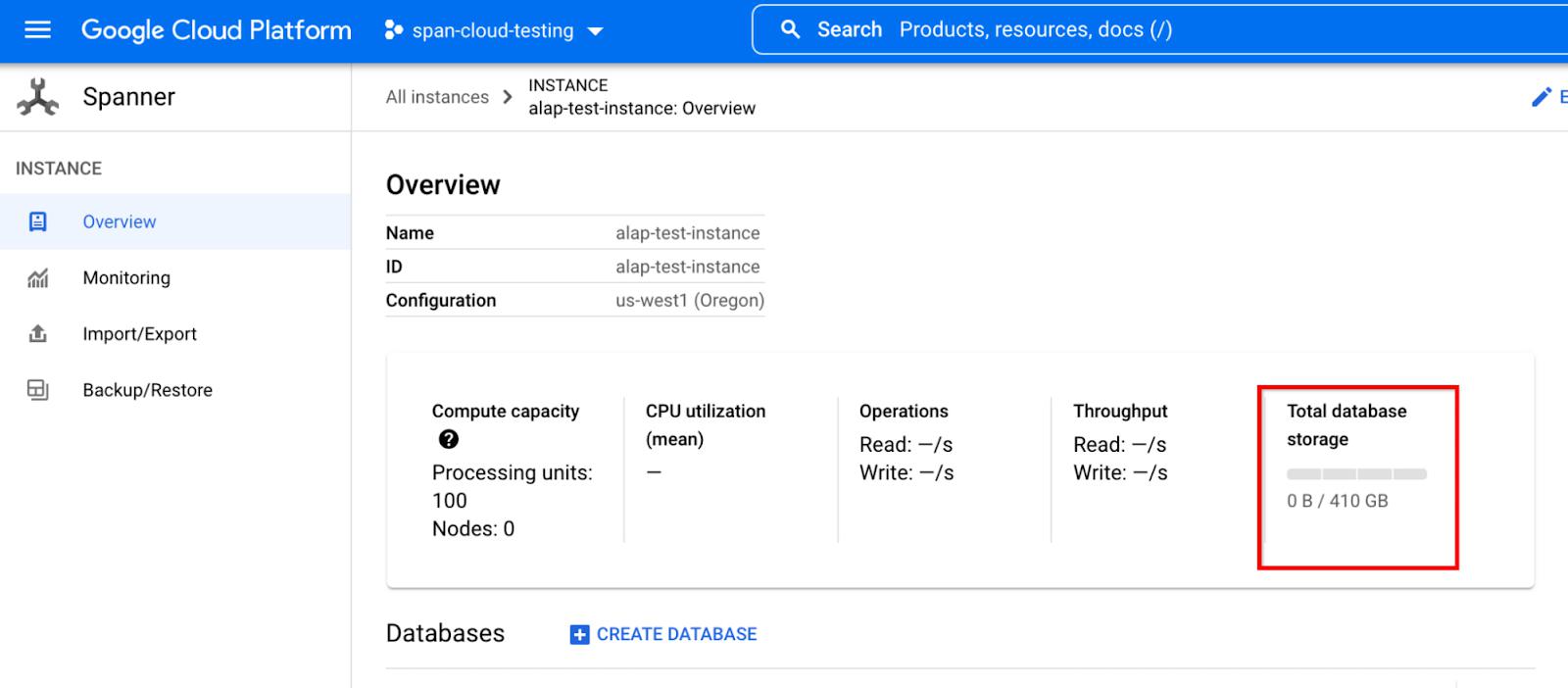
We’ve doubled the storage capacity for users who are using granular instance sizing (less than 1000 processing unit instances, or 1 node) as well. Each 100 processing units of compute capacity can support 410 GB of storage.
Read More  Garvan And Google Cloud Help Solve Australia’s Health Challenges With Genomics Sequencing


Previously if you had a storage-intensive workload, you had to over-provision compute (e.g. you had to provision at least 50 nodes of compute capacity to get a storage capacity of 100TB). Now, you can get more storage capacity without unnecessary compute (e.g. you can get 100TB of storage capacity with just 25 nodes). This provides an excellent opportunity to reduce your compute costs up to 50% for storage-intensive workloads.  However, be careful not to under-provision compute as per the below guidelines.

To gauge compute requirements, CPU utilization metrics can be used to monitor the present workload. Cloud Spanner uses CPU to serve read-write data requests as well as process background system tasks such as compaction and splitting. We recommend that you leave some head room for system tasks and unexpected bursts in data requests. When scaling down, we recommend you to monitor high priority CPU utilization to make sure it stays within the recommended limits for single or multi-region instances so that the CPU headroom can help in databases continuing to serve data requests even in case of zonal or regional failures. For single region instances, we recommend a high priority CPU utilization threshold of 65% and for multi-region instances, we recommend a high priority CPU utilization threshold of 45%. With the new storage capacity, if you are reducing the number of nodes, reduce it only up to the extent that these CPU utilization thresholds are not exceeded.

For example, with previous capacity, let us say you had 50 nodes and 100TB storage in your single region Spanner instance with 40% high CPU utilization. With the new limit, if you reduce the number of nodes to 25 from 50, high priority CPU utilization will rise to around 80% (above the recommended threshold of 65%).   So, in this case, you can reduce the number of nodes to 31 instead of reducing to 25, so that the CPU utilization is still below 65%. Please note that it’s recommended to scale down in stages to avoid performance impact.

Read More  Collegis Partners With Google Cloud To Unlock Value In Higher Education Data

In summary, Spanner has doubled the storage capacity for all instances from 2TB storage per node to 4TB storage per node to help reduce the compute cost of storage intensive workloads. For more information on Cloud Spanner, watch this youtube video or visit the Cloud Spanner documentation.


By: Matthew Mucklo (Staff Software Engineer) and Shambhu Hegde (Product Manager, Google Cloud)
Source: Google Cloud Blog


For enquiries, product placements, sponsorships, and collaborations, connect with us at [email protected]. We'd love to hear from you!

Our humans need coffee too! Your support is highly appreciated, thank you!

aster.cloud

Related Topics
  • Cloud Spanner
  • Databases
  • Google Cloud
  • Pricing
You May Also Like
Points, Lines and a Question
View Post
  • Architecture
  • Design
  • Engineering
  • People

What Is The Point In Making Points?

  • November 26, 2025
View Post
  • Engineering
  • Software Engineering

Development gets better with Age

  • October 9, 2025
View Post
  • Engineering
  • Technology

Apple supercharges its tools and technologies for developers to foster creativity, innovation, and design

  • June 9, 2025
View Post
  • Engineering

Just make it scale: An Aurora DSQL story

  • May 29, 2025
View Post
  • Engineering
  • Technology

Guide: Our top four AI Hypercomputer use cases, reference architectures and tutorials

  • March 9, 2025
View Post
  • Computing
  • Engineering

Why a decades old architecture decision is impeding the power of AI computing

  • February 19, 2025
View Post
  • Engineering
  • Software Engineering

This Month in Julia World

  • January 17, 2025
View Post
  • Engineering
  • Software Engineering

Google Summer of Code 2025 is here!

  • January 17, 2025

Stay Connected!
LATEST
  • 1
    Expectations vs. Reality: The AI We Thought We’d Have in 10 Years
    • June 19, 2026
  • digital-nomad-freelancer-worker-2151205464 2
    One paperwork problem – Get your Digital Nomad Visa employment documents fast from UK, EU or Singapore
    • June 16, 2026
  • 3
    Samsung Art Store Brings Art Basel to Homes Worldwide With New Curated Collection
    • June 15, 2026
  • 4
    You Do Not Need to Invest in the IPO of SpaceX, Anthropic, and OpenAI
    • June 10, 2026
  • 5
    The consequences of relying on AI for accurate news
    • June 10, 2026
  • 6
    Connecting AI agents with unstructured data using Google Cloud Storage MCP Servers
    • June 10, 2026
  • 7
    WWDC26: Apple unveils next generation of Apple Intelligence, Siri AI, powerful parental controls, and an expansive set of software improvements
    • June 8, 2026
  • 8
    IBM and Google Cloud Announce Strategic Partnership to Scale AI with Human Expertise and AI‑Powered Delivery
    • June 4, 2026
  • Data center 9
    Data Sovereignty in Spain. It’s Not Just About the Law, It’s About Efficiency
    • June 3, 2026
  • 10
    Ink vs Pixels. What you miss versus what you are actually missing.
    • June 1, 2026
about
Hello World!

We are aster.cloud. We’re created by programmers for programmers.

Our site aims to provide guides, programming tips, reviews, and interesting materials for tech people and those who want to learn in general.

We would like to hear from you.

If you have any feedback, enquiries, or sponsorship request, kindly reach out to us at:

[email protected]
Most Popular
  • 1
    Banks race to patch new cyber vulnerabilities, and other cybersecurity news
    • May 25, 2026
  • pope-leo-xiv-cq5dam-1500.844 2
    Pope Leo XIV to Publish First Encyclical on Artificial Intelligence and Human Dignity on 25 May
    • May 22, 2026
  • 3
    Portfolio to Clients, and is Strengthened by Ongoing Project Glasswing Work
    • May 20, 2026
  • reMarkable Paper Pure 4
    Everything The reMarkable Paper Pure Actually Does
    • May 14, 2026
  • 5
    Scaling cloud and AI: Microsoft Azure’s commitment to Europe’s digital future
    • May 11, 2026
  • /
  • Technology
  • Tools
  • About
  • Contact Us

Input your search keywords and press Enter.