The transition of telecommunications networks to the cloud has begun. Yet, simply containerizing network functions and running them on centralized or edge clouds will not maximize the cost savings and operational efficiencies promised by the cloud. A nominal change in technology from virtualized to containerized functions risks the same disappointments seen with the previous virtualization effort: minimal reductions in costs and continued rigidity in deployments.
Over the last two years, Communication Service Providers (CSPs) have been approaching Google Cloud to ask us how we created our network. How did we achieve economies of scale and build out a resilient, flexible network while flattening the cost curve? How can they seize the opportunity to do the same during this network transition to telco and edge cloud?
From our partners:
To address these questions, Google Cloud and the Linux Foundation are thrilled to announce the formation of project Nephio in partnership with leaders across the telecommunications industry to work towards true cloud native automation to drive scale, efficiency, and high reliability across network operations.
The term ‘cloud’ or ‘cloud-native’ indicates a set of key principles, from high infrastructure and network programmability to application awareness and intent, all the way to scaled economics. To date, “telco cloud” lacks the full realization and implementation of these principles because of the lack of true cloud native automation.
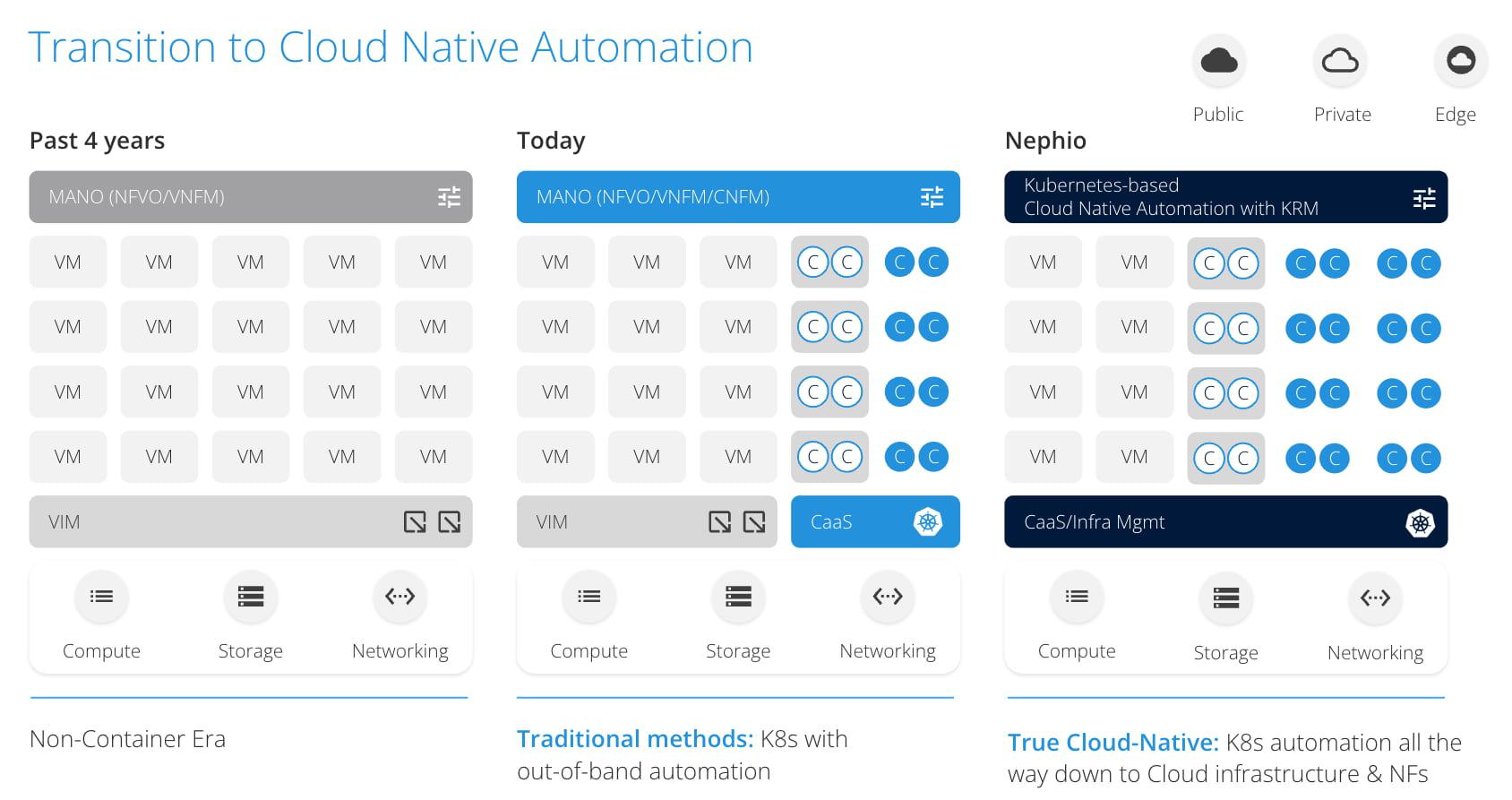

The first thing to note is that just shifting the network technology base from “virtualized” to “containerized” does not flatten the curve. In fact, it can increase costs due to additional infrastructure, new operating models, a more fragmented ecosystem, migration and skill and training efforts. Any shifts in network technology should only be made to support a more flexible and efficient operational model. For Google Cloud, this means that our global infrastructure is designed for the automation of both provisioning and ongoing operation, along with Site Reliability Engineering (SRE) best practices.
Google Cloud’s strategy to achieve this global automation efficiency is through the use of declarative, intent-based automation. In this automation model, operators specify their intention for the network configuration, and allow automated systems to actually make that intention real. Since the intention does not change as faults occur, networks grow, and environments shift, human interventions are not needed to adjust to those changes. Instead, automation simply does what it always does: evaluate the current state, compare it to the intended state, and take the actions needed to reconcile the two. Operations teams spend their time improving the automation, rather than fighting fires and implementing routine changes.
Google Cloud exported this idea for applications when we released Kubernetes, and the result has been widely adopted throughout the technology world. Google Cloud is now applying the same principles to the telecommunications network. Kubernetes extensibility can be leveraged to jump-start this process. We strongly believe that, without applying these techniques, the industry will fail to realize the benefits of the transition to cloud.
The telecommunications industry is complex, however, there are three key groups of players that must come together to realize the benefits of this transition:
- Cloud & Infrastructure Providers
- Network Function Vendors
- Communications Service Providers
Without any one of these groups mentioned above, the telecommunications industry will struggle to meet expectations.
Cloud and infrastructure providers must embrace open standards for configuration of their platforms, easing the burden on NF vendors for supporting each cloud. This also simplifies the automation; platform-neutral automation needs to be built, which can in turn delegate to the platform-specific components. This will require coordination between the platform vendors across the stack (silicon to cloud management).
Network function vendors must modernize their workloads. Notice the need to modernize, not simply containerize. Network functions must provide better separation from the infrastructure, or the automations become too complex. These workloads must become more transferable across hardware and cloud providers in order to enjoy the benefits of cloud-enabled scalability, self-healing, redundancy, and agility.
Finally, CSPs themselves must adapt and change their operational support models, embrace modern DevOps, intent-based design, and related methods. The way to truly achieve cost savings and agility is to let machines do the drudgery, and have operations teams focus on making the machines better.
Google Cloud’s experience has shown that scaling a global, resilient, and ever changing network is possible without similarly scaling the costs, by implementing cloud native, intent-based automation. With the start of the Nephio along with an ecosystem of network function vendors, cloud/infrastructure providers, CSPs and service orchestration partners, we are excited to work towards these goals together.
This project brings together these vital stakeholders to make sure we don’t miss this opportunity to dramatically reduce costs and increase agility. We really look forward to collaborating with the wider ecosystem in order to fully realize the overall business benefits of the journey to cloud via cloud native network automation.
To learn more about how Google Cloud is helping the Telecommunications industry go here.
By: Amol Phadke (Managing Director: Telecom Industry Solutions, Google Cloud) and Gabriele Di Piazza (Director of Product Management, Telecom, Google Cloud)
Source: Google Cloud Blog
For enquiries, product placements, sponsorships, and collaborations, connect with us at [email protected]. We'd love to hear from you!
Our humans need coffee too! Your support is highly appreciated, thank you!