aster.cloud aster.cloud
  • /
  • Platforms
    • Public Cloud
    • On-Premise
    • Hybrid Cloud
    • Data
  • Architecture
    • Design
    • Solutions
    • Enterprise
  • Engineering
    • Automation
    • Software Engineering
    • Project Management
    • DevOps
  • Programming
    • Learning
  • Tools
  • About
  • /
  • Platforms
    • Public Cloud
    • On-Premise
    • Hybrid Cloud
    • Data
  • Architecture
    • Design
    • Solutions
    • Enterprise
  • Engineering
    • Automation
    • Software Engineering
    • Project Management
    • DevOps
  • Programming
    • Learning
  • Tools
  • About
aster.cloud aster.cloud
  • /
  • Platforms
    • Public Cloud
    • On-Premise
    • Hybrid Cloud
    • Data
  • Architecture
    • Design
    • Solutions
    • Enterprise
  • Engineering
    • Automation
    • Software Engineering
    • Project Management
    • DevOps
  • Programming
    • Learning
  • Tools
  • About
  • Public Cloud
  • Software Engineering

GKE Release Channels: Balancing Innovation And Speed Of Change, Now With More Granular Controls

  • aster.cloud
  • June 21, 2022
  • 3 minute read

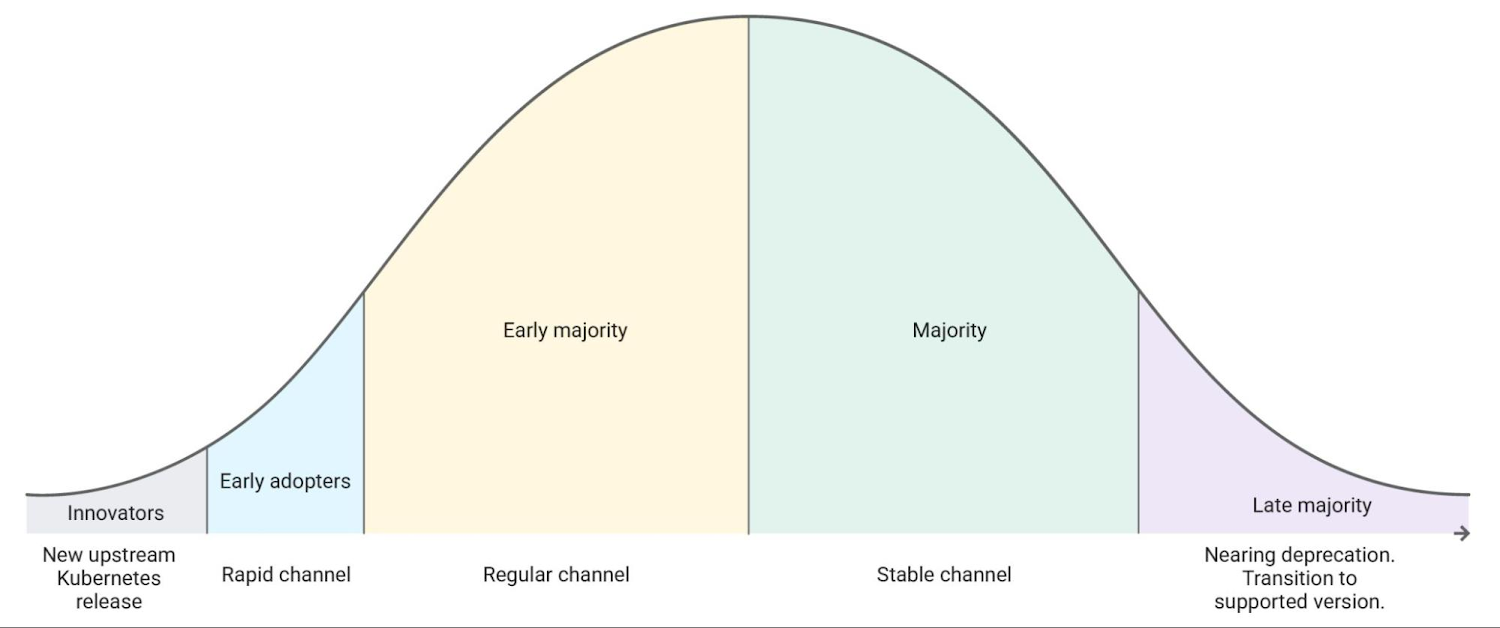
If you run your business on Kubernetes, you know how important it is to perform regular patching and upgrades to maintain a healthy environment. At Google Cloud, we automatically upgrade the Google Kubernetes Engine (GKE) cluster control plane, and if you enable node auto-upgrade, we also automatically upgrade and patch your cluster nodes. Moreover, you can  subscribe your cluster to a release channel that meets your constraints and needs — rapid, regular or stable. This is just one of the ways that GKE supports enterprises running production workloads, and is broadly used by GKE customers as part of their continuous upgrade strategy. For enterprises, release channels provide the level of predictability needed for advanced planning, and the flexibility to orchestrate custom workflows automatically when a change is scheduled (e.g. informing their DevOps team when a new security patch is available).
1 GKE Release Channels.jpg

While automating upgrades with release channels simplifies keeping track of Kubernetes versions and OSS compatibility, you may want to upgrade your cluster at specific times, for business continuity or quality assurance reasons. You may also want to control the scope of the upgrades —  apply just patches, or avoid minor releases — allowed on your cluster. This is critical, especially when you feel that an upgrade requires more qualification, testing, or preparation before it can be rolled out to production.


Partner with aster.cloud
for your next big idea.
Let us know here.


From our partners:

CITI.IO :: Business. Institutions. Society. Global Political Economy.
CYBERPOGO.COM :: For the Arts, Sciences, and Technology.
DADAHACKS.COM :: Parenting For The Rest Of Us.
ZEDISTA.COM :: Entertainment. Sports. Culture. Escape.
TAKUMAKU.COM :: For The Hearth And Home.
ASTER.CLOUD :: From The Cloud And Beyond.
LIWAIWAI.COM :: Intelligence, Inside and Outside.
GLOBALCLOUDPLATFORMS.COM :: For The World's Computing Needs.
FIREGULAMAN.COM :: For The Fire In The Belly Of The Coder.
ASTERCASTER.COM :: Supra Astra. Beyond The Stars.
BARTDAY.COM :: Prosperity For Everyone.

We recently enhanced the maintenance windows that you can set in GKE release channels. Previously, maintenance windows allowed you to specify “no upgrades” to the control plane or nodes for up to 30 days. Now, the upgrade-scope exclusion allows you to control and limit the scope of upgrades for up to 180 days, or end-of-life date, whichever comes first. Likewise, you can preclude minor upgrades and node upgrades from being applied to both your control planes and nodes with two new modes, “no_minor_upgrades” and “no_minor_or_nodes_upgrades”. And in both cases, you can “pin” your cluster to a specific minor k8s version (say 1.21) for a prolonged period of up to six months.

Read More  Identity & Access Management: Authentication With Cloud Identity

GKE release channels in action

German food-delivery network Delivery Hero is one GKE customer that recently began using release channels. With 791 million orders processed in the third quarter of 2021, Delivery Hero initially chose to eliminate potential disruptions to its customers by relying on a manual process to control the timing of changes, and reduce the risk that an untested update might impact availability. But this was not an ideal solution: constantly monitoring the Kubernetes release schedule, tracking version skew compatibility, and applying security patches was cumbersome.

In an effort to balance between risk mitigation and operational efficiency, Delivery Hero decided to subscribe their GKE clusters to a release channel. But in order to do it even more safely, they also defined the scope of auto-upgrades to include only patch versions, and to postpone minor upgrades. This way their GKE cluster is patched automatically to ensure security and compliance, but they hold back on minor version upgrades until they can be internally tested and qualified.

“Before the option to control upgrade scope, and especially the ability to postpone minor upgrades up to 6 months, we were struggling to align our qualification timeline with the cadence of Kubernetes OSS releases, especially with the API deprecations in recent releases,” said Kumar Saurabh Sinha, Engineering Manager (Platform & SRE) at Delivery Hero. “With upgrade scope exclusions, we managed to safely migrate our clusters and subscribe them on release channels while still having the ability to mitigate the risk of untested minor releases.”

Get started with GKE release channels today. When you create a new GKE cluster, it is automatically subscribed to the ‘regular’ release channel by default.

Read More  Delivering a secure, open, and sovereign digital world
2 GKE Release Channels.jpg

You can also migrate existing clusters onto release channels from the Google Cloud Console, or the command line. Read more here.

For example, if you want to subscribe a cluster to a release channel, and also to avoid minor Kubernetes upgrades for three months. You can follow these steps:

  • Ensure that clusters are running a version supported by the channel.
  • Exclude auto-upgrade for 24 hours. This is an optional safety step to avoid unplanned upgrades immediately after subscribing the cluster to a channel.
  • Subscribe the clusters to your desired release channel.
  • Set upgrade scope to no_minor_upgrades, allowing only patch versions to be applied to the cluster, while keeping the cluster on the same minor release.

With GKE release channels, you have the power to decide not only when, but how, and what to upgrade in your clusters and nodes. You can learn more about release channels here, and about maintenance windows here. And for even more, tune into this episode of the Google Cloud Platform Podcast, where my colleague Abdelfettah Sghiouar and I discuss the past and future of GKE release channels with the hosts Kaslin Fields and Mark Mirchandani.


By Kobi Magnezi Product Manager, Google Kubernetes Engine
Source Google Cloud


For enquiries, product placements, sponsorships, and collaborations, connect with us at [email protected]. We'd love to hear from you!

Our humans need coffee too! Your support is highly appreciated, thank you!

aster.cloud

Related Topics
  • GKE
  • Google Cloud
  • Google Kurbenetes Engine
You May Also Like
View Post
  • Public Cloud

Connecting AI agents with unstructured data using Google Cloud Storage MCP Servers

  • June 10, 2026
Data center
View Post
  • Data
  • Public Cloud

Data Sovereignty in Spain. It’s Not Just About the Law, It’s About Efficiency

  • June 3, 2026
View Post
  • Data
  • Platforms
  • Public Cloud

PayPal’s historically large data migration is the foundation for its gen AI innovation

  • March 4, 2026
Google Cloud and ElevenLabs
View Post
  • Public Cloud
  • Technology

ElevenLabs Partners with Google Cloud for Cloud Services and the Latest NVIDIA Blackwell GPUs

  • February 26, 2026
View Post
  • Public Cloud

Delivering a secure, open, and sovereign digital world

  • February 12, 2026
View Post
  • Public Cloud

Formula E and Google Cloud Announce Multi-Year ‘Principal Partnership’

  • January 26, 2026
View Post
  • Public Cloud

Sawasdee Thailand! Google Cloud launches new region in Bangkok

  • January 23, 2026
View Post
  • Public Cloud

Retailers Help Mitigate Risk with Oracle’s AI-Driven Supply Chain Collaboration

  • January 11, 2026

Stay Connected!
LATEST
  • 1
    Expectations vs. Reality: The AI We Thought We’d Have in 10 Years
    • June 19, 2026
  • digital-nomad-freelancer-worker-2151205464 2
    One paperwork problem – Get your Digital Nomad Visa employment documents fast from UK, EU or Singapore
    • June 16, 2026
  • 3
    Samsung Art Store Brings Art Basel to Homes Worldwide With New Curated Collection
    • June 15, 2026
  • 4
    You Do Not Need to Invest in the IPO of SpaceX, Anthropic, and OpenAI
    • June 10, 2026
  • 5
    The consequences of relying on AI for accurate news
    • June 10, 2026
  • 6
    Connecting AI agents with unstructured data using Google Cloud Storage MCP Servers
    • June 10, 2026
  • 7
    WWDC26: Apple unveils next generation of Apple Intelligence, Siri AI, powerful parental controls, and an expansive set of software improvements
    • June 8, 2026
  • 8
    IBM and Google Cloud Announce Strategic Partnership to Scale AI with Human Expertise and AI‑Powered Delivery
    • June 4, 2026
  • Data center 9
    Data Sovereignty in Spain. It’s Not Just About the Law, It’s About Efficiency
    • June 3, 2026
  • 10
    Ink vs Pixels. What you miss versus what you are actually missing.
    • June 1, 2026
about
Hello World!

We are aster.cloud. We’re created by programmers for programmers.

Our site aims to provide guides, programming tips, reviews, and interesting materials for tech people and those who want to learn in general.

We would like to hear from you.

If you have any feedback, enquiries, or sponsorship request, kindly reach out to us at:

[email protected]
Most Popular
  • 1
    Banks race to patch new cyber vulnerabilities, and other cybersecurity news
    • May 25, 2026
  • pope-leo-xiv-cq5dam-1500.844 2
    Pope Leo XIV to Publish First Encyclical on Artificial Intelligence and Human Dignity on 25 May
    • May 22, 2026
  • 3
    Portfolio to Clients, and is Strengthened by Ongoing Project Glasswing Work
    • May 20, 2026
  • reMarkable Paper Pure 4
    Everything The reMarkable Paper Pure Actually Does
    • May 14, 2026
  • 5
    Scaling cloud and AI: Microsoft Azure’s commitment to Europe’s digital future
    • May 11, 2026
  • /
  • Technology
  • Tools
  • About
  • Contact Us

Input your search keywords and press Enter.