aster.cloud aster.cloud
  • /
  • Platforms
    • Public Cloud
    • On-Premise
    • Hybrid Cloud
    • Data
  • Architecture
    • Design
    • Solutions
    • Enterprise
  • Engineering
    • Automation
    • Software Engineering
    • Project Management
    • DevOps
  • Programming
    • Learning
  • Tools
  • About
  • /
  • Platforms
    • Public Cloud
    • On-Premise
    • Hybrid Cloud
    • Data
  • Architecture
    • Design
    • Solutions
    • Enterprise
  • Engineering
    • Automation
    • Software Engineering
    • Project Management
    • DevOps
  • Programming
    • Learning
  • Tools
  • About
aster.cloud aster.cloud
  • /
  • Platforms
    • Public Cloud
    • On-Premise
    • Hybrid Cloud
    • Data
  • Architecture
    • Design
    • Solutions
    • Enterprise
  • Engineering
    • Automation
    • Software Engineering
    • Project Management
    • DevOps
  • Programming
    • Learning
  • Tools
  • About
  • Data
  • Public Cloud

How Carbon-Free Is Your Cloud? New Data Lets You Know

  • Aelia Vita
  • March 19, 2021
  • 3 minute read

Google first achieved carbon neutrality in 2007, and since 2017 we’ve purchased enough solar and wind energy to match 100% of our global electricity consumption. Now we’re building on that progress to target a new sustainability goal: running our business on carbon-free energy 24/7, everywhere, by 2030. Today, we’re sharing data about how we are performing against that objective, so our customers can select Google Cloud regions based on the carbon-free energy supplying them.

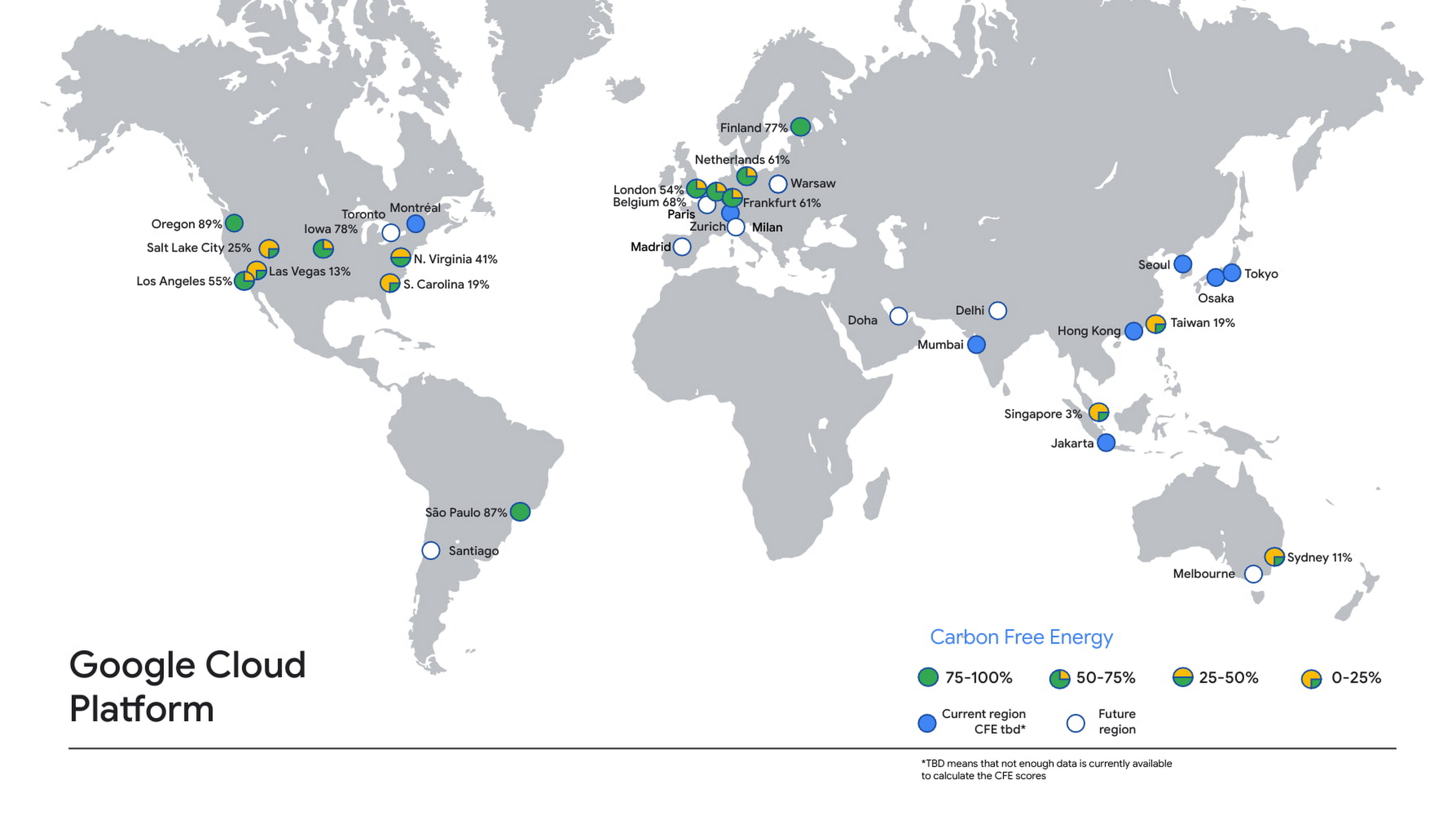
Completely decarbonizing our data center electricity supply is the critical next step in realizing a carbon-free future and supporting Google Cloud customers with the cleanest cloud in the industry. On the way to achieving this goal, each Google Cloud region will be supplied by a mix of more and more carbon-free energy and less and less fossil-based energy. We measure our progress along this path with our Carbon Free Energy Percentage (CFE%). Today we’re sharing the average hourly CFE% for the majority1 of our Google Cloud regions here and on GitHub.


Partner with aster.cloud
for your next big idea.
Let us know here.


From our partners:

CITI.IO :: Business. Institutions. Society. Global Political Economy.
CYBERPOGO.COM :: For the Arts, Sciences, and Technology.
DADAHACKS.COM :: Parenting For The Rest Of Us.
ZEDISTA.COM :: Entertainment. Sports. Culture. Escape.
TAKUMAKU.COM :: For The Hearth And Home.
ASTER.CLOUD :: From The Cloud And Beyond.
LIWAIWAI.COM :: Intelligence, Inside and Outside.
GLOBALCLOUDPLATFORMS.COM :: For The World's Computing Needs.
FIREGULAMAN.COM :: For The Fire In The Belly Of The Coder.
ASTERCASTER.COM :: Supra Astra. Beyond The Stars.
BARTDAY.COM :: Prosperity For Everyone.

Customers like Salesforce are already integrating environmental impact into their IT strategy as they work to decarbonize the services they provide to their customers. Patrick Flynn, VP of Sustainability at Salesforce, is committed to harnessing their culture of innovation to tackle climate change.

“At Salesforce we believe we must harness the power of innovation and technology across the customer relationship to address the challenge of climate change,” says Patrick Flynn, VP of Sustainability at Salesforce. “With Google’s new Carbon Free Energy Percentage, Salesforce can prioritize locations that maximize carbon free energy, reducing our footprint as we continue to deliver all our customers a carbon neutral cloud every day.”
Read More  Cloud Wisdom Weekly: 6 Tips To Optimize Data Management And Analytics
gcp regions.jpg

We’re sharing this data so you – like Salesforce – can incorporate carbon emissions into decisions on where to locate your services across our infrastructure. Just like the potential differences in a region’s price or latency, there are differences in the carbon emissions associated with the production of electricity that is sourced in each Google Cloud region.

The CFE% will tell you on average, how often that region was supplied with carbon-free energy on an hourly basis. Maximizing the amount of carbon-free energy that supplies your application or workload will help reduce the gross carbon emissions from running on it. Of course, all regions are matched with 100% carbon-free energy on an annual basis, so the CFE% tells you how well matched the carbon-free energy supply is with our demand. A lower-scoring region has more hours in the year without a matching, local amount of carbon-free energy.

As we work on increasing the CFE% for each of our Google Cloud regions, you can take advantage of locations with a higher percentage of carbon-free energy. You must also consider your data residency, performance and redundancy requirements, but here are some good ways to reduce the associated gross carbon emissions of your workload:

  1. Pick a lower-carbon region for your new applications. Cloud applications have a tendency to stay put once built, so build and run your new applications in the region with the highest CFE% available to you.
  2. Run batch jobs in a lower carbon region. Batch workloads are often planned ahead, so picking the region with the highest CFE% will increase the carbon-free energy supplying the job.
  3. Set an organizational policy for lower carbon regions. You can restrict the location of your cloud resources to a particular region or subset of regions using organizational policies. For example, if you want to use only US-based regions, restricting your workloads to run Iowa and Oregon, currently the leading CFE% leaders, rather than Las Vegas and S. Carolina would mean your app would be supplied by carbon-free energy an average of 68% more often.
Read More  Simplify Model Serving With Custom Prediction Routines On Vertex AI

And remember, the cleanest energy is the energy you didn’t use in the first place. Increasing the efficiency of your cloud applications will translate into using less energy, and often less carbon emissions. Try serverless products that automatically scale with your workload and take advantage of rightsizing recommendations for your compute instances.

24/7 carbon-free energy is the goal we’re chasing for all of our Google Cloud regions around the globe. Along the way, we’re working on new ways to help you make lower-carbon decisions and lower your Google Cloud Platform carbon footprint. Stay tuned, and make sure you read the full details of today’s launch here.


1. We’ll be updating the list as we receive data for additional regions.

By Carbon free for GCP team
Source Google Cloud Blog


For enquiries, product placements, sponsorships, and collaborations, connect with us at [email protected]. We'd love to hear from you!

Our humans need coffee too! Your support is highly appreciated, thank you!

Aelia Vita

Related Topics
  • Carbon-free
  • GCP
  • Google Cloud
  • Salesforce
You May Also Like
View Post
  • Public Cloud

Connecting AI agents with unstructured data using Google Cloud Storage MCP Servers

  • June 10, 2026
Data center
View Post
  • Data
  • Public Cloud

Data Sovereignty in Spain. It’s Not Just About the Law, It’s About Efficiency

  • June 3, 2026
View Post
  • Data
  • Platforms
  • Technology

Scaling cloud and AI: Microsoft Azure’s commitment to Europe’s digital future

  • May 11, 2026
View Post
  • Data

Streamline read scalability with Cloud SQL autoscaling read pools

  • March 23, 2026
View Post
  • Data
  • Platforms
  • Public Cloud

PayPal’s historically large data migration is the foundation for its gen AI innovation

  • March 4, 2026
Google Cloud and ElevenLabs
View Post
  • Public Cloud
  • Technology

ElevenLabs Partners with Google Cloud for Cloud Services and the Latest NVIDIA Blackwell GPUs

  • February 26, 2026
View Post
  • Public Cloud

Delivering a secure, open, and sovereign digital world

  • February 12, 2026
View Post
  • Public Cloud

Formula E and Google Cloud Announce Multi-Year ‘Principal Partnership’

  • January 26, 2026

Stay Connected!
LATEST
  • digital-nomad-freelancer-worker-2151205464 1
    One paperwork problem – Get your Digital Nomad Visa employment documents fast from UK, EU or Singapore
    • June 16, 2026
  • 2
    Samsung Art Store Brings Art Basel to Homes Worldwide With New Curated Collection
    • June 15, 2026
  • 3
    You Do Not Need to Invest in the IPO of SpaceX, Anthropic, and OpenAI
    • June 10, 2026
  • 4
    The consequences of relying on AI for accurate news
    • June 10, 2026
  • 5
    Connecting AI agents with unstructured data using Google Cloud Storage MCP Servers
    • June 10, 2026
  • 6
    WWDC26: Apple unveils next generation of Apple Intelligence, Siri AI, powerful parental controls, and an expansive set of software improvements
    • June 8, 2026
  • 7
    IBM and Google Cloud Announce Strategic Partnership to Scale AI with Human Expertise and AI‑Powered Delivery
    • June 4, 2026
  • Data center 8
    Data Sovereignty in Spain. It’s Not Just About the Law, It’s About Efficiency
    • June 3, 2026
  • 9
    Ink vs Pixels. What you miss versus what you are actually missing.
    • June 1, 2026
  • 10
    Banks race to patch new cyber vulnerabilities, and other cybersecurity news
    • May 25, 2026
about
Hello World!

We are aster.cloud. We’re created by programmers for programmers.

Our site aims to provide guides, programming tips, reviews, and interesting materials for tech people and those who want to learn in general.

We would like to hear from you.

If you have any feedback, enquiries, or sponsorship request, kindly reach out to us at:

[email protected]
Most Popular
  • pope-leo-xiv-cq5dam-1500.844 1
    Pope Leo XIV to Publish First Encyclical on Artificial Intelligence and Human Dignity on 25 May
    • May 22, 2026
  • 2
    Portfolio to Clients, and is Strengthened by Ongoing Project Glasswing Work
    • May 20, 2026
  • reMarkable Paper Pure 3
    Everything The reMarkable Paper Pure Actually Does
    • May 14, 2026
  • 4
    Scaling cloud and AI: Microsoft Azure’s commitment to Europe’s digital future
    • May 11, 2026
  • Anthropic Institute 5
    Introducing The Anthropic Institute
    • March 11, 2026
  • /
  • Technology
  • Tools
  • About
  • Contact Us

Input your search keywords and press Enter.