aster.cloud aster.cloud
  • /
  • Platforms
    • Public Cloud
    • On-Premise
    • Hybrid Cloud
    • Data
  • Architecture
    • Design
    • Solutions
    • Enterprise
  • Engineering
    • Automation
    • Software Engineering
    • Project Management
    • DevOps
  • Programming
    • Learning
  • Tools
  • About
  • /
  • Platforms
    • Public Cloud
    • On-Premise
    • Hybrid Cloud
    • Data
  • Architecture
    • Design
    • Solutions
    • Enterprise
  • Engineering
    • Automation
    • Software Engineering
    • Project Management
    • DevOps
  • Programming
    • Learning
  • Tools
  • About
aster.cloud aster.cloud
  • /
  • Platforms
    • Public Cloud
    • On-Premise
    • Hybrid Cloud
    • Data
  • Architecture
    • Design
    • Solutions
    • Enterprise
  • Engineering
    • Automation
    • Software Engineering
    • Project Management
    • DevOps
  • Programming
    • Learning
  • Tools
  • About
  • Engineering
  • Technology
  • Tools

What Is Cloud CDN And How Does It Work?

  • aster.cloud
  • November 22, 2021
  • 3 minute read

No matter what your app or website does, chances are that your users are distributed across various locations and are not necessarily close to your servers. This means the requests travel long distances across the public internet , leading to inconsistent and sometimes frustrating user experiences. That’s where Cloud CDN comes in!
Click to enlarge

What is Cloud CDN?

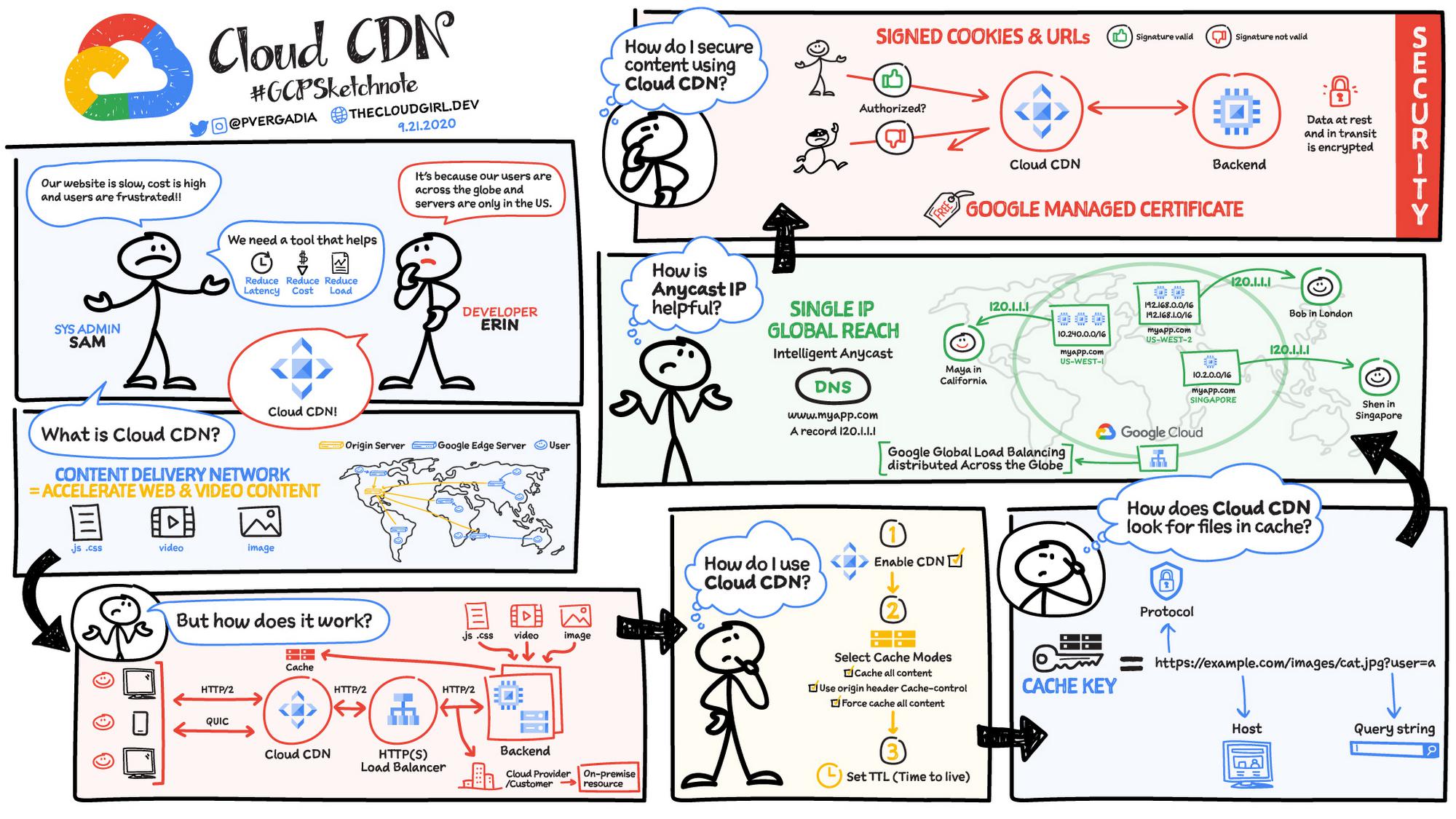
Cloud CDN is a content delivery network that accelerates your web and video content delivery by using Google’s global edge network to bring content as close to your users as possible. As a result latency, cost, and load on your backend servers is reduced, making it easier to scale to millions of users. Global anycast IP provides a single IP for global reach. It enables Google Cloud to route users to the nearest edge cache automatically and avoid DNS propagation delays that can impact availability. It supports HTTP/2 end-to-end and the QUIC protocol from client to cache. QUIC is a multiplexed stream transport over UDP, which reduces latency and makes it ideal for lossy mobile networks.


Partner with aster.cloud
for your next big idea.
Let us know here.


From our partners:

CITI.IO :: Business. Institutions. Society. Global Political Economy.
CYBERPOGO.COM :: For the Arts, Sciences, and Technology.
DADAHACKS.COM :: Parenting For The Rest Of Us.
ZEDISTA.COM :: Entertainment. Sports. Culture. Escape.
TAKUMAKU.COM :: For The Hearth And Home.
ASTER.CLOUD :: From The Cloud And Beyond.
LIWAIWAI.COM :: Intelligence, Inside and Outside.
GLOBALCLOUDPLATFORMS.COM :: For The World's Computing Needs.
FIREGULAMAN.COM :: For The Fire In The Belly Of The Coder.
ASTERCASTER.COM :: Supra Astra. Beyond The Stars.
BARTDAY.COM :: Prosperity For Everyone.

How does Cloud CDN work?

Let’s consider an example to understand how Cloud CDN works:

  • When a user makes a request to your website or app, the request is routed to the closest Google edge node (we have over 120 of these!) for fast and reliable traffic flow. From there the request gets routed to the global HTTPS Load Balancer to the backend or origin.
  • With Cloud CDN enabled, the content gets directly served from the cache — a group of servers that store and manage cacheable content so that future requests for that content can be served faster.
  • The cached content is a copy of cacheable web assets (JavaScript, CSS), images, video, and other content that is stored on your origin servers.
  • Cloud CDN automatically caches this content when you use the recommended “cache mode” to cache all static content. If you need more control, you can direct Cloud CDN by setting HTTP headers on your responses. You can also force all content to be cached; just know that this ignores  the “private”, “no-store”, or “no-cache” directives in Cache-Control response headers.
  • When the request is received by Cloud CDN it looks for the cached content using a cache key. This is typically the URI, but you can customize the cache key to remove protocol, hosts,or query strings.
  • If a cached response is found in the Cloud CDN cache, the response is retrieved from the cache and sent to the user. This is called a cache hit. When a cache hit occurs, Cloud CDN looks up the content by its cache key and responds directly to the user, shortening the round-trip time and reducing the load on the origin server.
  • The first time that a piece of content is requested, Cloud CDN can’t fulfill the request from the cache because it does not have it in cache. This is called a cache miss. When a cache miss occurs, Cloud CDN might attempt to get the content from a nearby cache. If the nearby cache has the content, it sends it to the first cache by using cache-to-cache fill. Otherwise, it just sends the request to the origin server.
  • The maximum lifetime of the object in a cache is defined by the TTLs, or time to live values, set by the cache directives for each HTTP response or cache mode. When the TTL expires, the content is evicted from cache.
Read More  Even More Pi In The Sky: Calculating 100 Trillion Digits Of Pi On Google Cloud

How to use Cloud CDN

You can set up Cloud CDN through gCloud CLI, Cloud Console, or the APIs. Since Cloud CDN uses Cloud Load Balancing to provide routing, health checking, and anycast IP support, it can be enabled by easily selecting a checkbox while setting up your backends or origins.

Cloud CDN makes it easy to serve web and media content using Google Cloud Storage. You just upload your content to a Cloud Storage bucket, set up your load balancer, and enable caching. To enable hybrid architectures spanning across clouds and on-premises, Cloud CDN and HTTP(S) Load Balancing also support external backends.

Security

  • Data is encrypted at rest and in transit from Cloud Load Balancing to the backend for end-to-end encryption.
  • You can programmatically sign URLs and cookies to limit video segment access to authorized users only. The signature is validated at the CDN edge and unauthorized requests are blocked right there!
  • On a broader level, you can enable SSL for free using Google managed certs!

For a more in-depth look into Cloud CDN check out the documentation.

For more #GCPSketchnote, follow the GitHub repo. For similar cloud content follow me on Twitter @pvergadia and keep an eye out on thecloudgirl.dev.

By: Priyanka Vergadia (Developer Advocate, Google)
Source: Google Cloud Blog


For enquiries, product placements, sponsorships, and collaborations, connect with us at [email protected]. We'd love to hear from you!

Our humans need coffee too! Your support is highly appreciated, thank you!

aster.cloud

Related Topics
  • Cloud CDN
  • Google Cloud
  • Networking
You May Also Like
View Post
  • Gears
  • Technology

Samsung Art Store Brings Art Basel to Homes Worldwide With New Curated Collection

  • June 15, 2026
View Post
  • Technology

The consequences of relying on AI for accurate news

  • June 10, 2026
View Post
  • Gears
  • Technology

WWDC26: Apple unveils next generation of Apple Intelligence, Siri AI, powerful parental controls, and an expansive set of software improvements

  • June 8, 2026
View Post
  • Technology

IBM and Google Cloud Announce Strategic Partnership to Scale AI with Human Expertise and AI‑Powered Delivery

  • June 4, 2026
View Post
  • Technology

Banks race to patch new cyber vulnerabilities, and other cybersecurity news

  • May 25, 2026
pope-leo-xiv-cq5dam-1500.844
View Post
  • Technology

Pope Leo XIV to Publish First Encyclical on Artificial Intelligence and Human Dignity on 25 May

  • May 22, 2026
View Post
  • Technology

Portfolio to Clients, and is Strengthened by Ongoing Project Glasswing Work

  • May 20, 2026
reMarkable Paper Pure
View Post
  • Gears
  • Technology

Everything The reMarkable Paper Pure Actually Does

  • May 14, 2026

Stay Connected!
LATEST
  • 1
    Expectations vs. Reality: The AI We Thought We’d Have in 10 Years
    • June 19, 2026
  • digital-nomad-freelancer-worker-2151205464 2
    One paperwork problem – Get your Digital Nomad Visa employment documents fast from UK, EU or Singapore
    • June 16, 2026
  • 3
    Samsung Art Store Brings Art Basel to Homes Worldwide With New Curated Collection
    • June 15, 2026
  • 4
    You Do Not Need to Invest in the IPO of SpaceX, Anthropic, and OpenAI
    • June 10, 2026
  • 5
    The consequences of relying on AI for accurate news
    • June 10, 2026
  • 6
    Connecting AI agents with unstructured data using Google Cloud Storage MCP Servers
    • June 10, 2026
  • 7
    WWDC26: Apple unveils next generation of Apple Intelligence, Siri AI, powerful parental controls, and an expansive set of software improvements
    • June 8, 2026
  • 8
    IBM and Google Cloud Announce Strategic Partnership to Scale AI with Human Expertise and AI‑Powered Delivery
    • June 4, 2026
  • Data center 9
    Data Sovereignty in Spain. It’s Not Just About the Law, It’s About Efficiency
    • June 3, 2026
  • 10
    Ink vs Pixels. What you miss versus what you are actually missing.
    • June 1, 2026
about
Hello World!

We are aster.cloud. We’re created by programmers for programmers.

Our site aims to provide guides, programming tips, reviews, and interesting materials for tech people and those who want to learn in general.

We would like to hear from you.

If you have any feedback, enquiries, or sponsorship request, kindly reach out to us at:

[email protected]
Most Popular
  • 1
    Banks race to patch new cyber vulnerabilities, and other cybersecurity news
    • May 25, 2026
  • pope-leo-xiv-cq5dam-1500.844 2
    Pope Leo XIV to Publish First Encyclical on Artificial Intelligence and Human Dignity on 25 May
    • May 22, 2026
  • 3
    Portfolio to Clients, and is Strengthened by Ongoing Project Glasswing Work
    • May 20, 2026
  • reMarkable Paper Pure 4
    Everything The reMarkable Paper Pure Actually Does
    • May 14, 2026
  • 5
    Scaling cloud and AI: Microsoft Azure’s commitment to Europe’s digital future
    • May 11, 2026
  • /
  • Technology
  • Tools
  • About
  • Contact Us

Input your search keywords and press Enter.