aster.cloud aster.cloud
  • /
  • Platforms
    • Public Cloud
    • On-Premise
    • Hybrid Cloud
    • Data
  • Architecture
    • Design
    • Solutions
    • Enterprise
  • Engineering
    • Automation
    • Software Engineering
    • Project Management
    • DevOps
  • Programming
    • Learning
  • Tools
  • About
  • /
  • Platforms
    • Public Cloud
    • On-Premise
    • Hybrid Cloud
    • Data
  • Architecture
    • Design
    • Solutions
    • Enterprise
  • Engineering
    • Automation
    • Software Engineering
    • Project Management
    • DevOps
  • Programming
    • Learning
  • Tools
  • About
aster.cloud aster.cloud
  • /
  • Platforms
    • Public Cloud
    • On-Premise
    • Hybrid Cloud
    • Data
  • Architecture
    • Design
    • Solutions
    • Enterprise
  • Engineering
    • Automation
    • Software Engineering
    • Project Management
    • DevOps
  • Programming
    • Learning
  • Tools
  • About
  • Engineering
  • Solutions
  • Tech

How To Publish Applications To Our Users Globally With Cloud DNS Routing Policies?

  • aster.cloud
  • January 26, 2022
  • 3 minute read

When building applications that are critical to your business, one key consideration is always high availability. In Google Cloud, we recommend building your strategic applications on a multi-regional architecture. In this article, we will see how Cloud DNS routing policies can help simplify your multi-regional design.

As an example, let’s take a web application that is internal to our company, such as a knowledge-sharing wiki application. It uses a classic 2-tier architecture: front-end servers tasked to serve web requests from our engineers and back-end servers containing the data for our application.


Partner with aster.cloud
for your next big idea.
Let us know here.


From our partners:

CITI.IO :: Business. Institutions. Society. Global Political Economy.
CYBERPOGO.COM :: For the Arts, Sciences, and Technology.
DADAHACKS.COM :: Parenting For The Rest Of Us.
ZEDISTA.COM :: Entertainment. Sports. Culture. Escape.
TAKUMAKU.COM :: For The Hearth And Home.
ASTER.CLOUD :: From The Cloud And Beyond.
LIWAIWAI.COM :: Intelligence, Inside and Outside.
GLOBALCLOUDPLATFORMS.COM :: For The World's Computing Needs.
FIREGULAMAN.COM :: For The Fire In The Belly Of The Coder.
ASTERCASTER.COM :: Supra Astra. Beyond The Stars.
BARTDAY.COM :: Prosperity For Everyone.

This application is used by our engineers based in the US (San Francisco), Europe (Paris) and Asia (Tokyo), so we decided to deploy our servers in three Google Cloud regions for better latency, performance and lower cost.
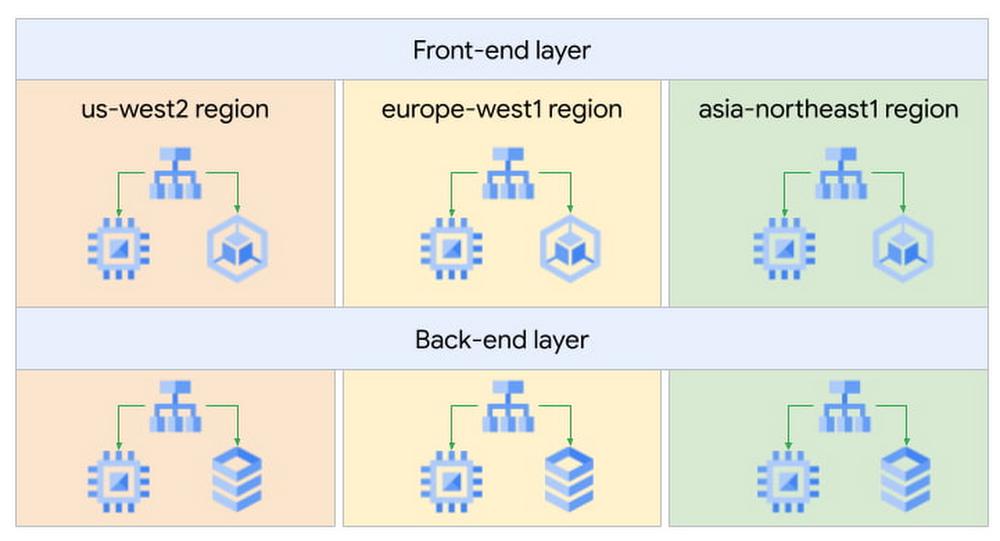
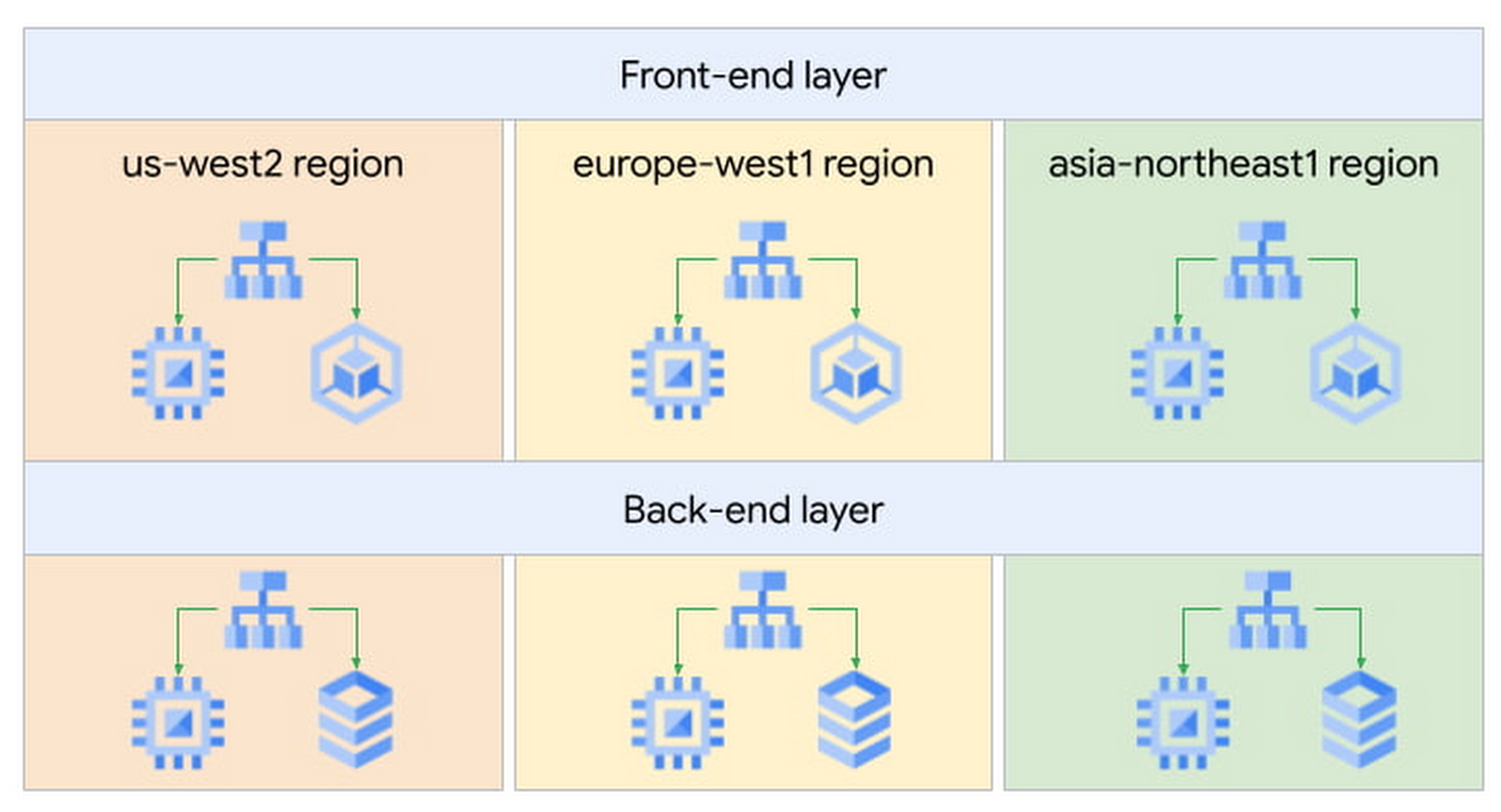
High level design


In each region, the wiki application is exposed via an Internal Load Balancer (ILB), which engineers connect to over an Interconnect or Cloud VPN connection.

Now our challenge is determining how to send users to the closest available front-end server.

Of course, we could use regional hostnames such as <region>.wiki.example.com where <region> is US, EU, or ASIA – but this puts the onus on the engineers to choose the correct region, exposing unnecessary complexity to our users. Additionally, it means that if the wiki application goes down in a region, the user has to manually change the hostname to another region – not very user-friendly!

So how could we design this better?

Using Cloud DNS Policy Manager, we could use a single global hostname such as wiki.example.com and use a geo-location policy to resolve this hostname to the endpoint closest to the end user. The geo-location policy will use the GCP region where the Interconnect or VPN lands as the source for the traffic and look for the closest available endpoint.

Read More  Cross-Region And Cross-Project Event Routing With Eventarc And Pub/Sub

For example, we would resolve the hostname for US users to the IP address of the US Internal Load Balancer in the below diagram:
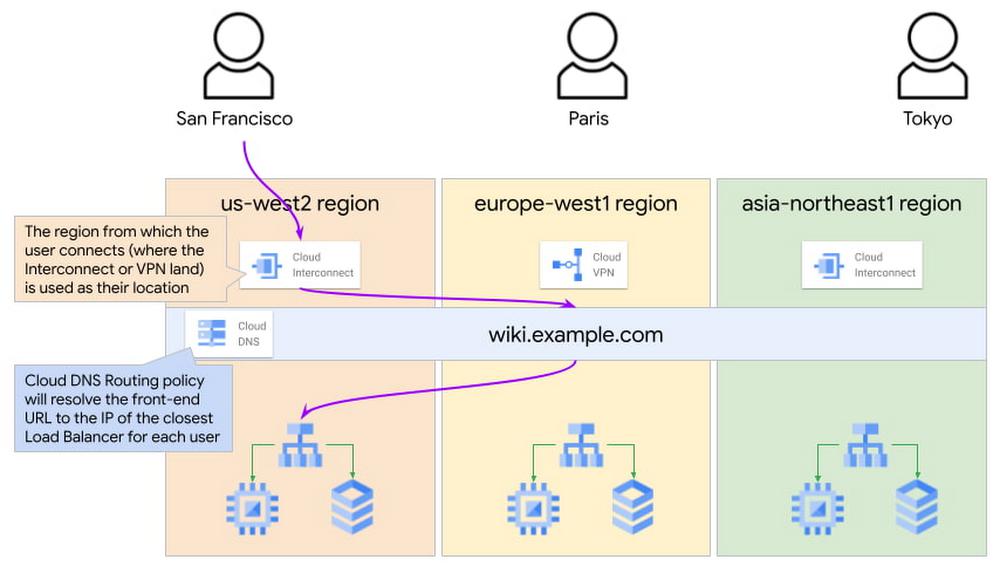
DNS resolution based on the location of the user


This allows us to have a simple configuration on the client side and to ensure a great user experience.

The Cloud DNS routing policy configuration would look like this:


gcloud dns managed-zones create wiki-private-zone \
    --description="DNS Zone for the front-end servers of the wiki application" \
    --dns-name=wiki.example.com \
    --networks=prod-vpc \
    --visibility=private

gcloud beta dns record-sets create front.wiki.example.com \
    --ttl=30 \
    --type=A \
    --zone=wiki-private-zone \
    --routing_policy_type=GEO \
--routing_policy_data="us-west2=10.128.1.2;europe-west1=10.130.1.2;asia-northeast1=10.132.1.2"


See the official documentation page for more information on how to configure Cloud DNS routing policies.

This configuration also helps us improve the reliability of our wiki application: if we were to lose the application in one region due to an incident, we can update the geo-location policy and remove the affected region from the configuration. This would mean that new users will resolve the next closest region to them, and it would not require an action on the client’s side or the application team’s side.

We have seen how this geo-location feature is great for sending users to the closest resource, but it can also be useful for machine-to-machine traffic.

Expanding on our web application example, we would like to ensure that front-end servers all have the same configuration globally and use the back-end servers in the same region.

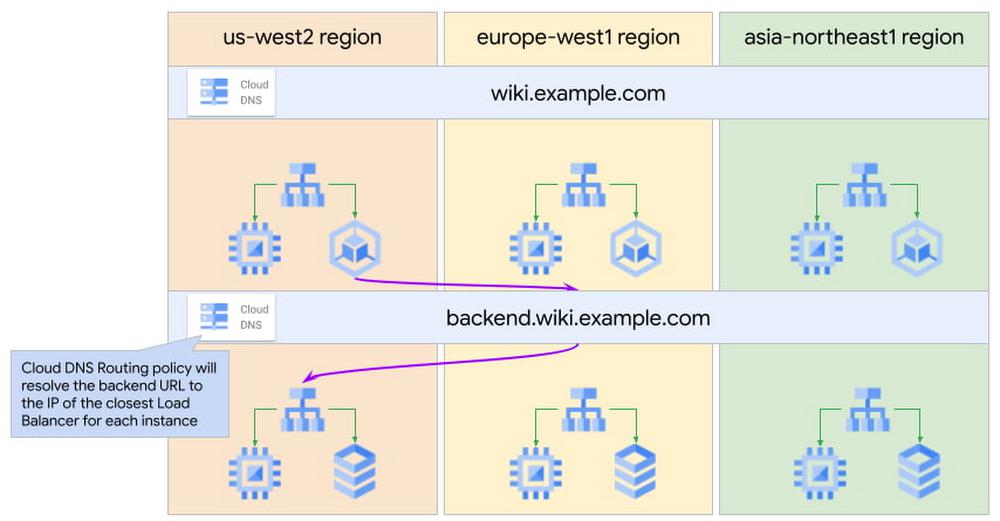
We would configure front-end servers to connect to the global hostname backend.wiki.example.com. The Cloud DNS geo-location policy will use the front-end servers’ GCP region information to resolve this hostname to the closest available backend tier Internal Load Balancer.
Read More  New Relic Expands Global Strategic Collaboration Agreement With AWS To Help Companies Accelerate Their Cloud Adoption Journey
Front-end to back-end communication (instance to instance)


Putting it all together, we now have a multi-regional and multi-tiered application with DNS policies to smartly route users to the closest instance of that application for optimal performance and costs.

In the next few months, we will introduce even smarter capabilities to Cloud DNS routing policies, such as health checks to allow automatic failovers. We look forward to sharing all these exciting new features with you in another blog post.


By: Aurelien Legrand (Strategic Cloud Engineer) and Karthik Balakrishnan (Cloud DNS Product Manager)
Source: Google Cloud Blog


For enquiries, product placements, sponsorships, and collaborations, connect with us at [email protected]. We'd love to hear from you!

Our humans need coffee too! Your support is highly appreciated, thank you!

aster.cloud

Related Topics
  • DNS
  • Google Cloud
  • Networking
  • Tutorial
You May Also Like
Smartphone hero image
View Post
  • Gears
  • Tech

Zed Approves | Smartphones for Every Budget Range

  • January 29, 2026
Points, Lines and a Question
View Post
  • Architecture
  • Design
  • Engineering
  • People

What Is The Point In Making Points?

  • November 26, 2025
Early Black Friday Gears
View Post
  • Tech

Friday Deals – And It’s Not Even Black Friday Yet

  • November 13, 2025
View Post
  • Engineering
  • Software Engineering

Development gets better with Age

  • October 9, 2025
View Post
  • Engineering
  • Technology

Apple supercharges its tools and technologies for developers to foster creativity, innovation, and design

  • June 9, 2025
View Post
  • Engineering

Just make it scale: An Aurora DSQL story

  • May 29, 2025
oracle-ibm
View Post
  • Solutions
  • Technology

Google Cloud and Philips Collaborate to Drive Consumer Marketing Innovation and Transform Digital Asset Management with AI

  • May 20, 2025
Getting things done makes her feel amazing
View Post
  • Computing
  • Data
  • Featured
  • Learning
  • Tech
  • Technology

Nurturing Minds in the Digital Revolution

  • April 25, 2025

Stay Connected!
LATEST
  • 1
    Expectations vs. Reality: The AI We Thought We’d Have in 10 Years
    • June 19, 2026
  • digital-nomad-freelancer-worker-2151205464 2
    One paperwork problem – Get your Digital Nomad Visa employment documents fast from UK, EU or Singapore
    • June 16, 2026
  • 3
    Samsung Art Store Brings Art Basel to Homes Worldwide With New Curated Collection
    • June 15, 2026
  • 4
    You Do Not Need to Invest in the IPO of SpaceX, Anthropic, and OpenAI
    • June 10, 2026
  • 5
    The consequences of relying on AI for accurate news
    • June 10, 2026
  • 6
    Connecting AI agents with unstructured data using Google Cloud Storage MCP Servers
    • June 10, 2026
  • 7
    WWDC26: Apple unveils next generation of Apple Intelligence, Siri AI, powerful parental controls, and an expansive set of software improvements
    • June 8, 2026
  • 8
    IBM and Google Cloud Announce Strategic Partnership to Scale AI with Human Expertise and AI‑Powered Delivery
    • June 4, 2026
  • Data center 9
    Data Sovereignty in Spain. It’s Not Just About the Law, It’s About Efficiency
    • June 3, 2026
  • 10
    Ink vs Pixels. What you miss versus what you are actually missing.
    • June 1, 2026
about
Hello World!

We are aster.cloud. We’re created by programmers for programmers.

Our site aims to provide guides, programming tips, reviews, and interesting materials for tech people and those who want to learn in general.

We would like to hear from you.

If you have any feedback, enquiries, or sponsorship request, kindly reach out to us at:

[email protected]
Most Popular
  • 1
    Banks race to patch new cyber vulnerabilities, and other cybersecurity news
    • May 25, 2026
  • pope-leo-xiv-cq5dam-1500.844 2
    Pope Leo XIV to Publish First Encyclical on Artificial Intelligence and Human Dignity on 25 May
    • May 22, 2026
  • 3
    Portfolio to Clients, and is Strengthened by Ongoing Project Glasswing Work
    • May 20, 2026
  • reMarkable Paper Pure 4
    Everything The reMarkable Paper Pure Actually Does
    • May 14, 2026
  • 5
    Scaling cloud and AI: Microsoft Azure’s commitment to Europe’s digital future
    • May 11, 2026
  • /
  • Technology
  • Tools
  • About
  • Contact Us

Input your search keywords and press Enter.