aster.cloud aster.cloud
  • /
  • Platforms
    • Public Cloud
    • On-Premise
    • Hybrid Cloud
    • Data
  • Architecture
    • Design
    • Solutions
    • Enterprise
  • Engineering
    • Automation
    • Software Engineering
    • Project Management
    • DevOps
  • Programming
    • Learning
  • Tools
  • About
  • /
  • Platforms
    • Public Cloud
    • On-Premise
    • Hybrid Cloud
    • Data
  • Architecture
    • Design
    • Solutions
    • Enterprise
  • Engineering
    • Automation
    • Software Engineering
    • Project Management
    • DevOps
  • Programming
    • Learning
  • Tools
  • About
aster.cloud aster.cloud
  • /
  • Platforms
    • Public Cloud
    • On-Premise
    • Hybrid Cloud
    • Data
  • Architecture
    • Design
    • Solutions
    • Enterprise
  • Engineering
    • Automation
    • Software Engineering
    • Project Management
    • DevOps
  • Programming
    • Learning
  • Tools
  • About
  • Engineering

Demonstrating Your K8s Scheduler With Kube-Scheduler-Simulator In A Real Cluster

  • aster.cloud
  • December 6, 2022
  • 3 minute read
In the previous post, I wrote how we can develop our own scheduler with kube-scheduler-simulator. If you could implemented your new scheduler, you may want to try it in a real cluster.In this article, I describe how to port a scheduler implementation, which is designed to work with kube-scheduler-simulator, into a real cluster, and a way to demonstrate the difference between the new scheduler and the default one by using the frontend part of kube-scheduler-simulator.

How to deploy your scheduler into a real cluster?

An official document “Configure Multiple Schedulers” contains an explanation of how to deploy a scheduler to a cluster. What we can learn from this article is that even considering schedulers, that sounds special, but nothing is different than other controllers. The most important fact in this context is: a scheduler is an executable command.


Partner with aster.cloud
for your next big idea.
Let us know here.


From our partners:

CITI.IO :: Business. Institutions. Society. Global Political Economy.
CYBERPOGO.COM :: For the Arts, Sciences, and Technology.
DADAHACKS.COM :: Parenting For The Rest Of Us.
ZEDISTA.COM :: Entertainment. Sports. Culture. Escape.
TAKUMAKU.COM :: For The Hearth And Home.
ASTER.CLOUD :: From The Cloud And Beyond.
LIWAIWAI.COM :: Intelligence, Inside and Outside.
GLOBALCLOUDPLATFORMS.COM :: For The World's Computing Needs.
FIREGULAMAN.COM :: For The Fire In The Belly Of The Coder.
ASTERCASTER.COM :: Supra Astra. Beyond The Stars.
BARTDAY.COM :: Prosperity For Everyone.

If you developed a new scheduler in kube-scheduler-simulator tree, as I described in the previous post, it must be a golang package. Now, to evaluate the scheduler in a real cluser, you have to wrap it by main().

Build minisched as a executable command

As a funny example, I choose minisched (initial-random-scheduler version) again. It provides us a clear result of this experiment, in other words, its behavior is totally different than the default scheduler.

Here is a simple example of main() for minisched.

package main

import (
	"context"
	"flag"
	"k8s.io/apiserver/pkg/server"
	"k8s.io/client-go/informers"
	"k8s.io/client-go/kubernetes"
	"k8s.io/client-go/tools/clientcmd"
	"k8s.io/klog/v2"
	"example.com/kube-random-scheduler/minisched"
)

func main() {
	kubeconfig := flag.String("kubeconfig", "", "kubeconfig config file")
	flag.Parse()

	config, err := clientcmd.BuildConfigFromFlags("", *kubeconfig)
	if err != nil {
		klog.Fatalf("Error building kubeconfig: %s", err.Error())
	}

	clientset, err := kubernetes.NewForConfig(config)
	if err != nil {
		klog.Fatalf("Error building example clientset: %s", err.Error())
	}

	ctx, cancel := context.WithCancel(context.Background())
	defer cancel()
	go func() {
		stopCh := server.SetupSignalHandler()
		<-stopCh
		cancel()
	}()
	informerFactory := informers.NewSharedInformerFactory(clientset, 0)
	sched := minisched.New(clientset, informerFactory)
	informerFactory.Start(ctx.Done())
	informerFactory.WaitForCacheSync(ctx.Done())
	sched.Run(ctx)
}

To build this, you need the following file structure.

kube-random-scheduler
├── main.go
└── minisched

minisched in this tree should be copied from mini-kube-scheduler, and you may need to modify import urls in minisched/initialize.go as follows.

Patch license: MIT (same as mini-kube-scheduler)

--- a/minisched/initialize.go
+++ b/minisched/initialize.go
@@ -1,7 +1,7 @@
 package minisched

 import (
-       "github.com/sanposhiho/mini-kube-scheduler/minisched/queue"
+       "example.com/kube-random-scheduler/minisched/queue"
        "k8s.io/client-go/informers"
        clientset "k8s.io/client-go/kubernetes"
 )

Now you can build this by following commands.

$ go mod init example.com/kube-random-scheduler
$ go mod tidy
$ CGO_ENABLED=0 go build -v -o kube-random-scheduler main.go

Once you have built an executable file, you can deploy it by following the instructions in the official document, Configure Multiple Schedulers. Note that you should remove livenessProbe and readinessProbe in the example manifest because the above main() doesn’t have a healthz implementation.

Read More  Best Practices Of Migrating Hive ACID Tables To BigQuery

Visualize scheduler behavior by kube-scheduler-simulator

I’ve been wanted to visualize the low level behavior of my scheduler implementation. Since the Dashboard is not sufficient for that purpose, I decided to use the frontend part of kube-scheduler-simulator.

kube-scheduler-simulator is consists of three containers, simulator-server, simulator-etcd and simulator-frontend. The simulator-frontend is a Nuxt.js app communicating with simulator-server by REST APIs. These APIs are compatible to the original K8s implementation, so we can connect the simulator-frontend to the kube-apiserver in a real cluseter. This enables us to visualize the low level behavior of schedulers in a real cluster.
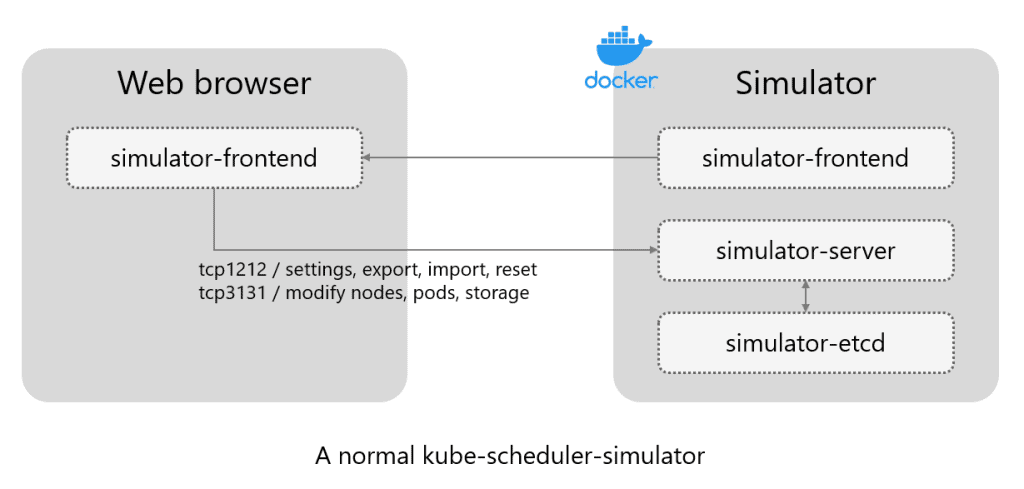
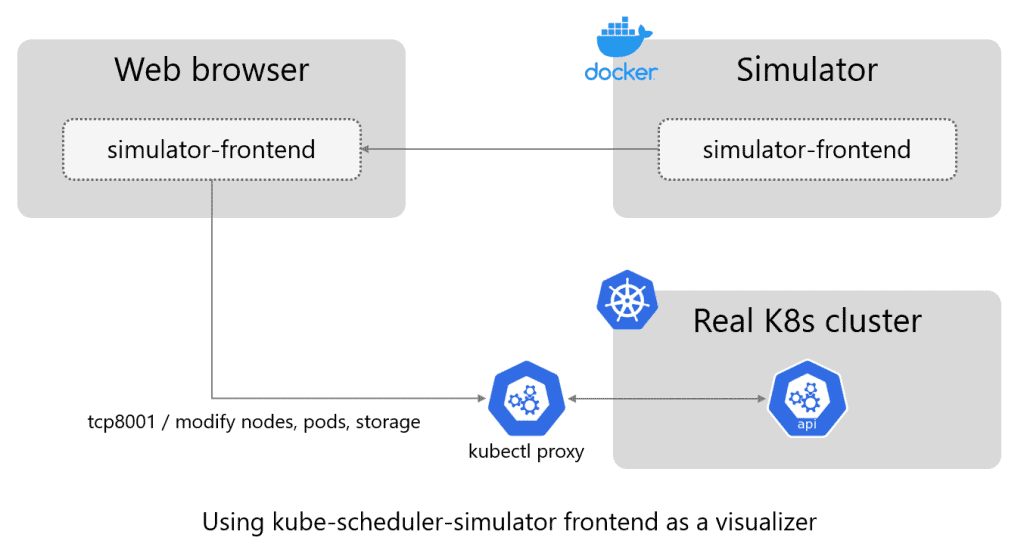
Firstly, you need to add a --cors-allowed-origins option for kube-apiserver of your cluster.

--- kube-apiserver.yaml.orig    2022-09-01 18:06:34.983636661 +0900
+++ kube-apiserver.yaml 2022-09-01 18:06:12.459666678 +0900
@@ -13,6 +13,7 @@
   containers:
   - command:
     - kube-apiserver
+    - --cors-allowed-origins=http://*
     - --advertise-address=192.168.1.51
     - --allow-privileged=true
     - --anonymous-auth=True

Then, start kubectl proxy on the same host running kube-scheduler-simulator.

simulator-pc$ docker-compose up -d simulator-frontend
simulator-pc$ kubectl proxy

Finally, create tunnel to kube-scheduler-simulator and kubectl proxy on the host your web browser is running.

frontend-pc$ ssh -L 3000:localhost:3000 -L 3131:localhost:8001 simulator-pc

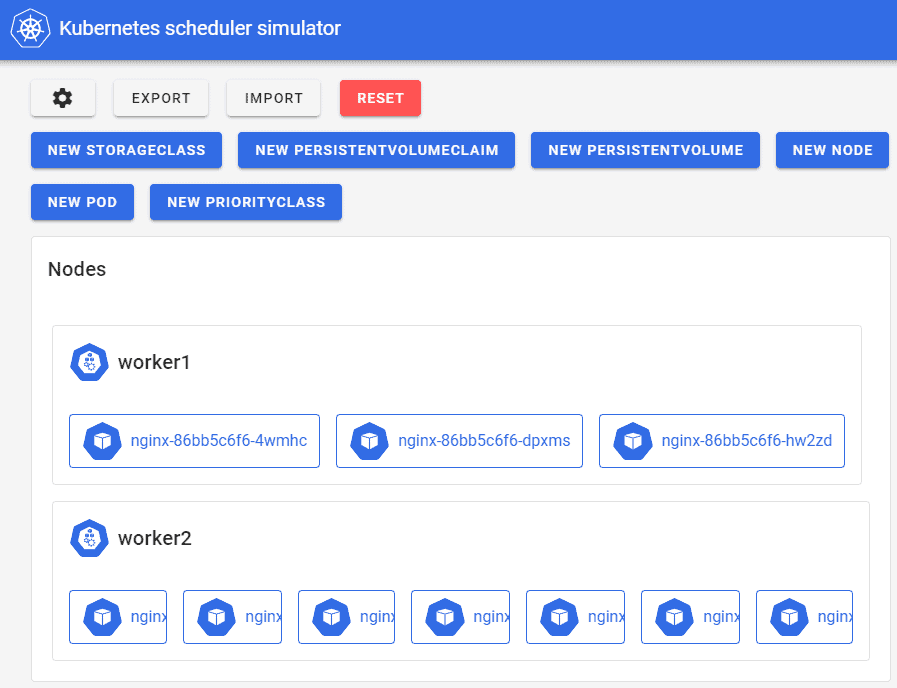
If you successfully done, you can view funny results of the random scheduler in browser, pods are randomly assigned to nodes.
Conclusion

  • Schedulers should be developed in the form of single executable command
  • You can use kube-scheduler-simulator as a visualizer for a real cluster

References

  • https://github.com/kubernetes-sigs/kube-scheduler-simulator
  • https://github.com/sanposhiho/mini-kube-scheduler/tree/initial-random-scheduler/minisched
  • https://kubernetes.io/docs/tasks/extend-kubernetes/configure-multiple-schedulers/
  • Trademarks and registered trademarks of other companies

Guest post originally published on the Miraxia blog
By: Takuma Kawai

Source: CNCF Blog


For enquiries, product placements, sponsorships, and collaborations, connect with us at [email protected]. We'd love to hear from you!

Our humans need coffee too! Your support is highly appreciated, thank you!

aster.cloud

Related Topics
  • Cloud Native Computing Foundation
  • Docker
  • Go
  • Kubernetes
  • Tutorials
You May Also Like
Points, Lines and a Question
View Post
  • Architecture
  • Design
  • Engineering
  • People

What Is The Point In Making Points?

  • November 26, 2025
View Post
  • Engineering
  • Software Engineering

Development gets better with Age

  • October 9, 2025
View Post
  • Engineering
  • Technology

Apple supercharges its tools and technologies for developers to foster creativity, innovation, and design

  • June 9, 2025
View Post
  • Engineering

Just make it scale: An Aurora DSQL story

  • May 29, 2025
View Post
  • Engineering
  • Technology

Guide: Our top four AI Hypercomputer use cases, reference architectures and tutorials

  • March 9, 2025
View Post
  • Computing
  • Engineering

Why a decades old architecture decision is impeding the power of AI computing

  • February 19, 2025
View Post
  • Engineering
  • Software Engineering

This Month in Julia World

  • January 17, 2025
View Post
  • Engineering
  • Software Engineering

Google Summer of Code 2025 is here!

  • January 17, 2025

Stay Connected!
LATEST
  • 1
    Expectations vs. Reality: The AI We Thought We’d Have in 10 Years
    • June 19, 2026
  • digital-nomad-freelancer-worker-2151205464 2
    One paperwork problem – Get your Digital Nomad Visa employment documents fast from UK, EU or Singapore
    • June 16, 2026
  • 3
    Samsung Art Store Brings Art Basel to Homes Worldwide With New Curated Collection
    • June 15, 2026
  • 4
    You Do Not Need to Invest in the IPO of SpaceX, Anthropic, and OpenAI
    • June 10, 2026
  • 5
    The consequences of relying on AI for accurate news
    • June 10, 2026
  • 6
    Connecting AI agents with unstructured data using Google Cloud Storage MCP Servers
    • June 10, 2026
  • 7
    WWDC26: Apple unveils next generation of Apple Intelligence, Siri AI, powerful parental controls, and an expansive set of software improvements
    • June 8, 2026
  • 8
    IBM and Google Cloud Announce Strategic Partnership to Scale AI with Human Expertise and AI‑Powered Delivery
    • June 4, 2026
  • Data center 9
    Data Sovereignty in Spain. It’s Not Just About the Law, It’s About Efficiency
    • June 3, 2026
  • 10
    Ink vs Pixels. What you miss versus what you are actually missing.
    • June 1, 2026
about
Hello World!

We are aster.cloud. We’re created by programmers for programmers.

Our site aims to provide guides, programming tips, reviews, and interesting materials for tech people and those who want to learn in general.

We would like to hear from you.

If you have any feedback, enquiries, or sponsorship request, kindly reach out to us at:

[email protected]
Most Popular
  • 1
    Banks race to patch new cyber vulnerabilities, and other cybersecurity news
    • May 25, 2026
  • pope-leo-xiv-cq5dam-1500.844 2
    Pope Leo XIV to Publish First Encyclical on Artificial Intelligence and Human Dignity on 25 May
    • May 22, 2026
  • 3
    Portfolio to Clients, and is Strengthened by Ongoing Project Glasswing Work
    • May 20, 2026
  • reMarkable Paper Pure 4
    Everything The reMarkable Paper Pure Actually Does
    • May 14, 2026
  • 5
    Scaling cloud and AI: Microsoft Azure’s commitment to Europe’s digital future
    • May 11, 2026
  • /
  • Technology
  • Tools
  • About
  • Contact Us

Input your search keywords and press Enter.