aster.cloud aster.cloud
  • /
  • Platforms
    • Public Cloud
    • On-Premise
    • Hybrid Cloud
    • Data
  • Architecture
    • Design
    • Solutions
    • Enterprise
  • Engineering
    • Automation
    • Software Engineering
    • Project Management
    • DevOps
  • Programming
    • Learning
  • Tools
  • About
  • /
  • Platforms
    • Public Cloud
    • On-Premise
    • Hybrid Cloud
    • Data
  • Architecture
    • Design
    • Solutions
    • Enterprise
  • Engineering
    • Automation
    • Software Engineering
    • Project Management
    • DevOps
  • Programming
    • Learning
  • Tools
  • About
aster.cloud aster.cloud
  • /
  • Platforms
    • Public Cloud
    • On-Premise
    • Hybrid Cloud
    • Data
  • Architecture
    • Design
    • Solutions
    • Enterprise
  • Engineering
    • Automation
    • Software Engineering
    • Project Management
    • DevOps
  • Programming
    • Learning
  • Tools
  • About
  • Data
  • Solutions
  • Technology

Establish Consistent Business Language And Improve Trust In Your Data

  • aster.cloud
  • February 8, 2023
  • 3 minute read

Today we announce the Dataplex business glossary, now available in public preview. Dataplex is an intelligent data fabric that provides a way to manage, monitor, and govern your distributed data at scale. Dataplex business glossary offers users a cloud-native way to maintain and manage their business terms and definitions, establishing consistent business language, improving trust in data, and enabling self-serve use of data.

In enterprises, small, medium, or large, there are many different teams. Each team, over time, develops its own language. For example, for a corporate team, “customer” could mean “legal entity,” whereas for the central platform team, it could be individuals/legal entities/government entities, etc. This dissonance can lead to collaboration challenges and, worse, to misinterpretation of data and affect insights and decisions. This dissonance also prevents users unfamiliar with the area from having a self-service path, leaving them dependent on tribal knowledge in the organization. Navigating it introduces manual overhead and makes it hard to stay updated with changes.


Partner with aster.cloud
for your next big idea.
Let us know here.


From our partners:

CITI.IO :: Business. Institutions. Society. Global Political Economy.
CYBERPOGO.COM :: For the Arts, Sciences, and Technology.
DADAHACKS.COM :: Parenting For The Rest Of Us.
ZEDISTA.COM :: Entertainment. Sports. Culture. Escape.
TAKUMAKU.COM :: For The Hearth And Home.
ASTER.CLOUD :: From The Cloud And Beyond.
LIWAIWAI.COM :: Intelligence, Inside and Outside.
GLOBALCLOUDPLATFORMS.COM :: For The World's Computing Needs.
FIREGULAMAN.COM :: For The Fire In The Belly Of The Coder.
ASTERCASTER.COM :: Supra Astra. Beyond The Stars.
BARTDAY.COM :: Prosperity For Everyone.

With Dataplex business glossary, users can now :

  • capture their business terminology within glossaries and terms
  • enrich cataloged data entries with this business terminology by attaching defined terms to data entry columns
  • describe semantic relationships between terms by establishing cross-term associations.
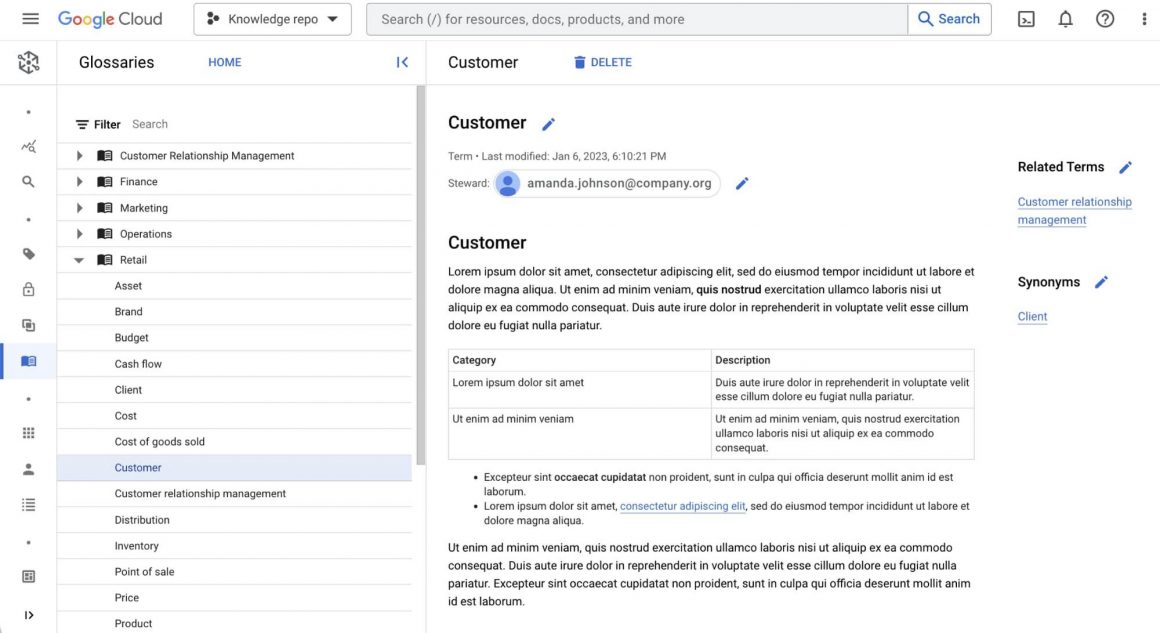
Dataplex business glossary supports data practitioners in several ways. Firstly, it promotes semantic consistency in defining and interpreting data across teams, which helps to minimize redundancy and reduce the possibility of confusion and misinterpretation when consuming data. For example, with a centrally curated definition of the term ‘retail transaction,’ when two teams produce two different data assets capturing details of retail transactions, they would structure these data assets consistently according to the defined terminology.

Read More  Step-By-Step Guide To Resolve DEADLINE_EXCEEDED Errors On Cloud Spanner

Semantic consistency,in turn, reinforces understanding of and trust in data. When attached to data assets, glossary terms provide an additional layer of centrally curated and consistent business context that allows users to confidently establish the degree to which the data assets fit for their purpose. In the above example of customer data, an analyst searching for “show me all customer tables” does not have to worry about varying interpretations for identified data assets, i.e., whether they refer to personal customers or legal entities, etc. With business glossary, the correct interpretation is established via associated glossary terms which provide the required context for these data assets and allow the analyst to identify the relevance of discovered data more reliably.

All the above then unlocks self-serve use of data, allowing users to leverage glossary content to discover data assets (e.g. through search queries like “Show me all entries which attached glossary terms referencing ‘retail transaction’ anywhere in their definitions” – note how search can address varying term metadata, including descriptions and associated Data Stewards, when identifying data assets), understand the semantics of these data assets, and consequently – identify applicable usage scenarios for these data assets.

Additionally, Dataplex business glossary can support data governance, with data governance teams using glossary context for informing data governance policy configuration decisions. For example, these teams can consider data assets associated with glossary terms referencing “customer” for additional access control policies related to customer data handling.

In summary, you can leverage the Dataplex business glossary alongside the broad set of Dataplex data governance capabilities to enable users to establish a common and consistent business language, strengthen trust in data, promote self-serve use, and get value from your data.

Read More  Huawei Cloud Pangu-Weather Model Now Available On European Weather Agency Website

How do I get started?

To get started with Dataplex business glossary, visit the Glossaries tab in Dataplex. You can capture business terminology by defining glossaries, terms, and cross-term relationships.

You can then associate cataloged entries with defined terms as you browse data entries in Dataplex Search.

Once glossary content is defined and associated with data entries, you can leverage glossary content in discovery and search.

For more information:

  • Learn how to use Dataplex business glossary
  • Visit Dataplex on Google Cloud

By: Andrew Ikonnikov (Product Manager) and Ragi Mahil (Head of Product Marketing, Advanced Analytics)
Source: Google Cloud Blog


For enquiries, product placements, sponsorships, and collaborations, connect with us at [email protected]. We'd love to hear from you!

Our humans need coffee too! Your support is highly appreciated, thank you!

aster.cloud

Related Topics
  • Data Analytics
  • Dataplex
  • Google Cloud
You May Also Like
View Post
  • Gears
  • Technology

Samsung Art Store Brings Art Basel to Homes Worldwide With New Curated Collection

  • June 15, 2026
View Post
  • Technology

The consequences of relying on AI for accurate news

  • June 10, 2026
View Post
  • Gears
  • Technology

WWDC26: Apple unveils next generation of Apple Intelligence, Siri AI, powerful parental controls, and an expansive set of software improvements

  • June 8, 2026
View Post
  • Technology

IBM and Google Cloud Announce Strategic Partnership to Scale AI with Human Expertise and AI‑Powered Delivery

  • June 4, 2026
Data center
View Post
  • Data
  • Public Cloud

Data Sovereignty in Spain. It’s Not Just About the Law, It’s About Efficiency

  • June 3, 2026
View Post
  • Technology

Banks race to patch new cyber vulnerabilities, and other cybersecurity news

  • May 25, 2026
pope-leo-xiv-cq5dam-1500.844
View Post
  • Technology

Pope Leo XIV to Publish First Encyclical on Artificial Intelligence and Human Dignity on 25 May

  • May 22, 2026
View Post
  • Technology

Portfolio to Clients, and is Strengthened by Ongoing Project Glasswing Work

  • May 20, 2026

Stay Connected!
LATEST
  • digital-nomad-freelancer-worker-2151205464 1
    One paperwork problem – Get your Digital Nomad Visa employment documents fast from UK, EU or Singapore
    • June 16, 2026
  • 2
    Samsung Art Store Brings Art Basel to Homes Worldwide With New Curated Collection
    • June 15, 2026
  • 3
    You Do Not Need to Invest in the IPO of SpaceX, Anthropic, and OpenAI
    • June 10, 2026
  • 4
    The consequences of relying on AI for accurate news
    • June 10, 2026
  • 5
    Connecting AI agents with unstructured data using Google Cloud Storage MCP Servers
    • June 10, 2026
  • 6
    WWDC26: Apple unveils next generation of Apple Intelligence, Siri AI, powerful parental controls, and an expansive set of software improvements
    • June 8, 2026
  • 7
    IBM and Google Cloud Announce Strategic Partnership to Scale AI with Human Expertise and AI‑Powered Delivery
    • June 4, 2026
  • Data center 8
    Data Sovereignty in Spain. It’s Not Just About the Law, It’s About Efficiency
    • June 3, 2026
  • 9
    Ink vs Pixels. What you miss versus what you are actually missing.
    • June 1, 2026
  • 10
    Banks race to patch new cyber vulnerabilities, and other cybersecurity news
    • May 25, 2026
about
Hello World!

We are aster.cloud. We’re created by programmers for programmers.

Our site aims to provide guides, programming tips, reviews, and interesting materials for tech people and those who want to learn in general.

We would like to hear from you.

If you have any feedback, enquiries, or sponsorship request, kindly reach out to us at:

[email protected]
Most Popular
  • pope-leo-xiv-cq5dam-1500.844 1
    Pope Leo XIV to Publish First Encyclical on Artificial Intelligence and Human Dignity on 25 May
    • May 22, 2026
  • 2
    Portfolio to Clients, and is Strengthened by Ongoing Project Glasswing Work
    • May 20, 2026
  • reMarkable Paper Pure 3
    Everything The reMarkable Paper Pure Actually Does
    • May 14, 2026
  • 4
    Scaling cloud and AI: Microsoft Azure’s commitment to Europe’s digital future
    • May 11, 2026
  • Anthropic Institute 5
    Introducing The Anthropic Institute
    • March 11, 2026
  • /
  • Technology
  • Tools
  • About
  • Contact Us

Input your search keywords and press Enter.