In a new book, Richard “Dick” Larson draws on a lifelong commitment to STEM education at MIT to offer accessible advice on solving everyday problems and making smarter decisions.
Scott Murray | Institute for Data, Systems, and Society
MIT News (https://news.mit.edu/2023/learning-how-to-learn-model-thinking-1019)
From our partners:
Suppose you need to be on today’s only ferry to Martha’s Vineyard, which leaves at 2 p.m. It takes about 30 minutes (on average) to drive from where you are to the terminal. What time should you leave?
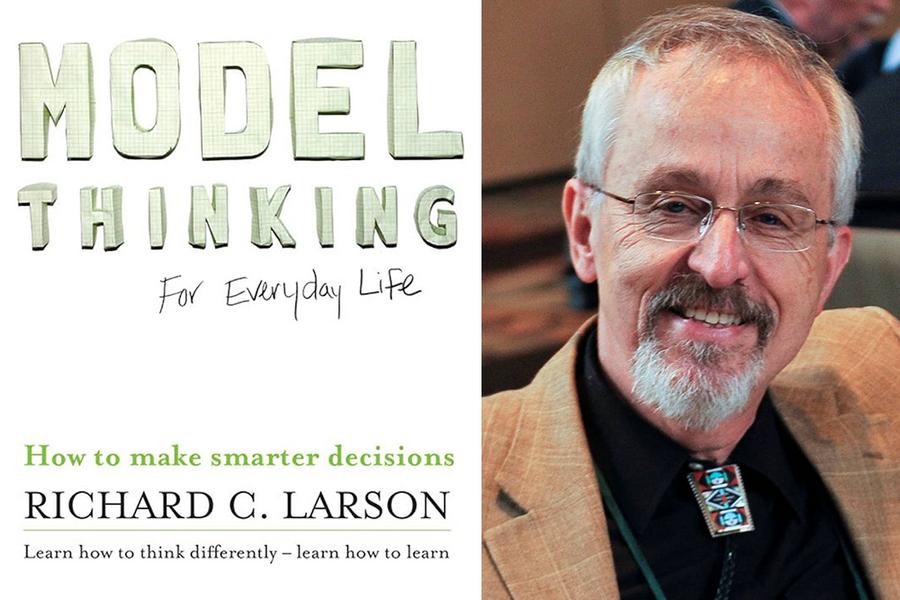
This is one of many common real-life examples used by Richard “Dick” Larson, a post-tenure professor in the MIT Institute for Data, Systems, and Society (IDSS), to explore exemplary problem-solving in his new book “Model Thinking for Everyday Life: How to Make Smarter Decisions.”
Larson’s book synthesizes a lifelong career as an MIT professor and researcher, highlighting crucial skills underpinning all empirical, rational, and critical thinking. “Critical thinkers are energetic detectives … always seeking the facts,” he says. “Additional facts may surface that can result in modified conclusions … A critical thinker is aware of the pitfalls of human intuition.”
For Larson, “model” thinking means not only thinking aided by conceptual and/or mathematical models, but a broader mode of critical thought that is informed by STEM concepts and worthy of emulation.
In the ferry example, a key concept at play is uncertainty. Accounting for uncertainty is a core challenge faced by systems engineers, operations researchers, and modelers of complex networks — all hats Larson has worn in over half a century at MIT.
Uncertainty complicates all prediction and decision-making, and while statistics offers tactics for managing uncertainty, “Model Thinking” is not a math textbook. There are equations for the math-curious, but it doesn’t take a degree from MIT to understand that
- an average of 30 minutes would cover a range of times, some shorter, some longer;
- outliers can exist in the data, like the time construction traffic added an additional 30 minutes
- “about 30 minutes” is a prediction based on past experience, not current information (road closures, accidents, etc.); and
- the consequence for missing the ferry is not a delay of hours, but a full day — which might completely disrupt the trip or its purpose.
And so, without doing much explicit math, you calculate variables, weigh the likelihood of different outcomes against the consequences of failure, and choose a departure time. Larson’s conclusion is one championed by dads everywhere: Leave on the earlier side, just in case.
“The world’s most important, invisible profession”
Throughout Larson’s career at MIT, he has focused on the science of solving problems and making better decisions. “Faced with a new problem, people often lack the ability to frame and formulate it using basic principles,” argues Larson. “Our emphasis is on problem framing and formulation, with mathematics and physics playing supporting roles.”
This is operations research, which Larson calls “the world’s most important invisible profession.” Formalized as a field during World War II, operations researchers use data and models to try to derive the “physics” of complex systems. The goal is typically optimizing things like scheduling, routing, simulation, prediction, planning, logistics, and queueing, for which Larson is especially well-known. A frequent media expert on the subject, he earned the moniker “Dr. Q” — and his research has led to new approaches for easing congestion in urban traffic, fast-food lines, and banks.
Larson’s experience with complex systems provides a wealth of examples to draw on, but he is keen to demonstrate that his purview includes everyday decisions, and that “Model Thinking” is a book for everyone.
“Everybody uses models, whether they realize it or not,” he says. “If you have a bunch of errands to do, and you try to plan out the order to do them so you don’t have to drive as much, that’s more or less the ‘traveling salesman’ problem, a classic from operations research. Or when someone is shopping for groceries and thinking about how much of each product they need — they’re basically using an inventory management model of their pantry.”
Larson’s takeaway is that since we all use conceptual models for thinking, planning, and decision-making, then understanding howour minds use models, and learning to use them more intentionally, can lead to clearer thinking, better planning, and smarter decision-making — especially when they are grounded in principles drawn from math and physics.
Passion for the process
Teaching STEM principles has long been a mission of Larson’s, who co-founded MIT BLOSSOMS (Blended Learning Open Source Science or Math Studies) with his late wife, Mary Elizabeth Murray. BLOSSOMS provides free, interactive STEM lessons and videos for primary school students around the world. Some of the exercises in “Model Thinking” refer to these videos as well.
“A child’s educational opportunities shouldn’t be limited by where they were born or the wealth of their parents,” says Larson of the enterprise.
It was also Murray who encouraged Larson to write “Model Thinking.” “She saw how excited I was about it,” he says. “I had the choice of writing a textbook on queuing, say, or something else. It didn’t excite me at all.”
Larson’s passion is for the process, not the answer. Throughout the book, he marks off opportunities for active learning with an icon showing the two tools necessary to complete each task: a sharpened pencil and a blank sheet of paper.
“Many of us in the age of instant Google searches have lost the ability — or perhaps the patience — to undertake multistep problems,” he argues.
Model thinkers, on the other hand, understand and remember solutions better for having thought through the steps, and can better apply what they’ve learned to future problems. Larson’s “homework” is to docritical thinking, not just read about it. By working through thought experiments and scenarios, readers can achieve a deeper understanding of concepts like selection bias, random incidence, and orders of magnitude, all of which can present counterintuitive examples to the uninitiated.
For Larson, who jokes that he is “an evangelist for models,” there is no better way to learn than by doing — except perhaps to teach. “Teaching a difficult topic is our best way to learn it ourselves, is an unselfish act, and bonds the teacher and learner,” he writes.
In his long career as an educator and education advocate, Larson says he has always remained a learner himself. His love for learning illuminates every page of “Model Thinking,” which he hopes will provide others with the enjoyment and satisfaction that comes from learning new things and solving complex problems.
“You will learn how to learn,” Larson says. “And you will enjoy it!”
Reprinted with permission of MIT News (http://news.mit.edu/)
Source: cyberpogo.com
For enquiries, product placements, sponsorships, and collaborations, connect with us at [email protected]. We'd love to hear from you!
Our humans need coffee too! Your support is highly appreciated, thank you!