aster.cloud aster.cloud
  • /
  • Platforms
    • Public Cloud
    • On-Premise
    • Hybrid Cloud
    • Data
  • Architecture
    • Design
    • Solutions
    • Enterprise
  • Engineering
    • Automation
    • Software Engineering
    • Project Management
    • DevOps
  • Programming
    • Learning
  • Tools
  • About
  • /
  • Platforms
    • Public Cloud
    • On-Premise
    • Hybrid Cloud
    • Data
  • Architecture
    • Design
    • Solutions
    • Enterprise
  • Engineering
    • Automation
    • Software Engineering
    • Project Management
    • DevOps
  • Programming
    • Learning
  • Tools
  • About
aster.cloud aster.cloud
  • /
  • Platforms
    • Public Cloud
    • On-Premise
    • Hybrid Cloud
    • Data
  • Architecture
    • Design
    • Solutions
    • Enterprise
  • Engineering
    • Automation
    • Software Engineering
    • Project Management
    • DevOps
  • Programming
    • Learning
  • Tools
  • About
  • Data
  • Engineering

Announcing Apache Iceberg Support For BigLake

  • aster.cloud
  • November 17, 2022
  • 4 minute read
Apache Iceberg is a popular open source table format for customers looking to build data lakes. It provides many features found in enterprise data warehouses, such as transactional DML, time travel, schema evolution, and advanced metadata that unlocks performance optimization. Iceberg’s open specification allows customers to run multiple query engines on a single copy of data stored in an object store. Backed by a growing community of contributors, Apache Iceberg is becoming the de facto open standard for data lakes, bringing interoperability across clouds for hybrid analytical workloads and systems to exchange data.Earlier this year, we announced BigLake, a storage engine that enables customers to store data in open file formats (such as Parquet) on Google Cloud Storage and run GCP and open source query engines on it in a secure, governed, and performant manner. BigLake unifies data warehouses and lakes by enabling BigQuery and open source frameworks like Spark to access data with fine-grained access control. Today, we are excited to announce that this support now extends to the Apache Iceberg format, enabling customers to take advantage of Iceberg’s capabilities to build an open format data lake while benefiting from native GCP integration using BigLake.“Besides BigQuery, a large segment of our data is stored on GCS. Our Datalake leveraged Iceberg to tap into this data in an efficient and scalable way on top of incredibly large datasets. BigLake integration makes this even easier by making this data available to our large BigQuery user base and leverage its powerful UI. Our users now have the ability to realize most BigQuery benefits on GCS data as if this was stored natively.” — Bo Chen, Sr. Manager of Data and Insights at Snap Inc.

Read More  How Your Company Catches The AI Wave(s)

Build a secure and governed Iceberg data lake with BigLake’s fine-grained security model

BigLake enables multi-compute architecture: Iceberg tables created in supported open source analytics engines can be read using BigQuery.


Partner with aster.cloud
for your next big idea.
Let us know here.


From our partners:

CITI.IO :: Business. Institutions. Society. Global Political Economy.
CYBERPOGO.COM :: For the Arts, Sciences, and Technology.
DADAHACKS.COM :: Parenting For The Rest Of Us.
ZEDISTA.COM :: Entertainment. Sports. Culture. Escape.
TAKUMAKU.COM :: For The Hearth And Home.
ASTER.CLOUD :: From The Cloud And Beyond.
LIWAIWAI.COM :: Intelligence, Inside and Outside.
GLOBALCLOUDPLATFORMS.COM :: For The World's Computing Needs.
FIREGULAMAN.COM :: For The Fire In The Belly Of The Coder.
ASTERCASTER.COM :: Supra Astra. Beyond The Stars.
BARTDAY.COM :: Prosperity For Everyone.

# Creation of table using Iceberg format with Dataproc Spark 

CREATE TABLE catalog.db.table (col1 type1, col2 type2) USING iceberg TBLPROPERTIES(bq_table='{bigquery_table}', bq_connection='{bigquery_connection}');

Once the table has been created in Spark, easily query using BigQuery:
# Query table using the BigQuery console 

SELECT COL1, COL2 FROM bigquery_table LIMIT 10;
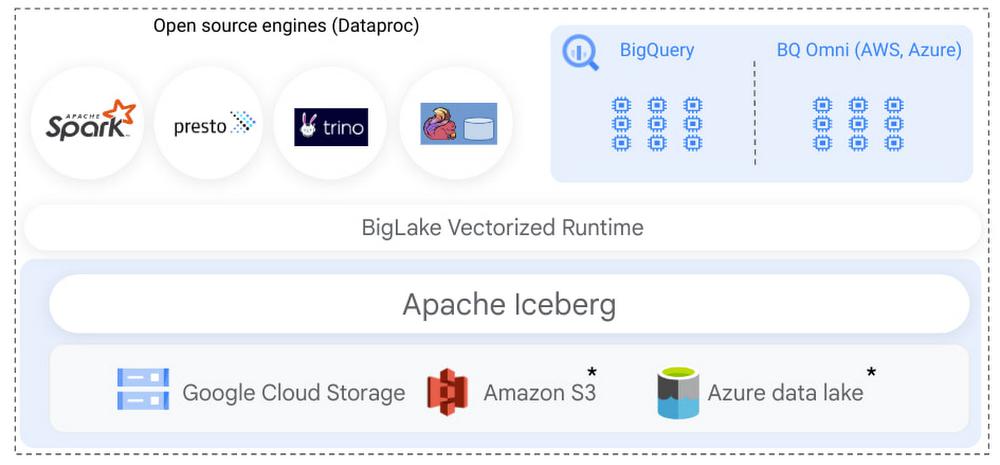
Apache Spark already has rich support for Iceberg, allowing customers to use Iceberg’s core capabilities, such as DML, transactions, and schema evolution, to carry out large-scale transformation and data processing. Customers can run Spark using Dataproc (managed clusters or serverless), or use built-in support for Apache Spark in BigQuery (stored procedures) to process Iceberg tables hosted on Google Cloud Storage. Regardless of your choice of Spark, BigLake automatically makes those Iceberg tables available for end users to query.Administrators can now use Iceberg tables, similar to BigLake tables, and don’t need to provide end users access to the underlying GCS bucket. The end user access is delegated through BigLake, simplifying access management and governance. Administrators can further secure Iceberg tables using fine-grained access policies, such as row, column level access control, or data masking, extending the existing BigLake governance framework to Iceberg tables. BigQuery utilizes Iceberg’s metadata for query execution, providing a performant query experience to end users.
This set of capabilities enables customers to store a single copy of data on object stores using Iceberg and run BigQuery as well as Dataproc workloads on it in a secure, governed, and performant manner, eliminating the need to duplicate data or write custom infrastructure. For GCP customers who store their data on BigQuery Storage and Google Cloud Storage, BigLake now further unifies data lake and warehouse workloads. Customers can directly query, join, secure, and govern data across BigQuery storage and Iceberg tables on Google Cloud Storage. In the coming months, we will extend Apache Iceberg to Amazon S3 and Azure data lake Gen 2, enabling customers to build multi-cloud Iceberg data lakes.

Read More  Know More, Spend Less: How GKE Cost Optimization Insights Help You Optimize Kubernetes

Differentiate your Iceberg workloads with native BigQuery and GCP integration

The benefits of running Iceberg on Google Cloud extend beyond realizing Iceberg’s core capabilities and BigLake’s fine-grained security model. Customers can use native BigQuery and GCP integration to use BigQuery’s differentiated services on Iceberg tables created over Google Cloud Storage data. Some key integrations most relevant in the context of Iceberg are:

  • Securely exchange Iceberg data using Analytics Hub – Iceberg as an open standard provides interoperability between various storage systems and query engines to exchange data. On Google Cloud, customers use Analytics hub to share BigQuery & BigLake tables with their partners, customers, and suppliers without needing to copy data. Similar to BigQuery tables, data providers can now create shared datasets to share Iceberg tables on Google Cloud storage. Consumers of the shared data can use any Iceberg compatible supported query engine to consume the data, providing an open and governed model of sharing and consuming data.
  • Run data science workloads on Iceberg using BigQueryML – Customers can now use BigQueryML to extend their machine learning workloads to Iceberg tables stored on Google cloud storage, enabling customers to realize AI value on data stored outside of BigQuery.
  • Discover, detect and protect PII data on Iceberg using Cloud DLP – Customers can now use Cloud DLP to identify, discover and secure PII data elements contained in Iceberg tables, and secure sensitive data using BigLake’s fine-grained security model to meet workload compliance.

Get Started

Learn more about BigLake support for Apache Iceberg by watching this demo video, and a panel discussion of customers building using BigLake with Iceberg. Apache Iceberg support for BigLake is currently in preview, sign up to get started. Contact a Google sales representative to learn how Apache Iceberg can help evolve your data architecture.

Read More  Stories From The Crypto Industry That Will Keep You Up At Night

Special mention to the engineering leadership of Micah Kornfield, Anoop Johnson, Garrett Casto, Justin Levandoski and team to make this launch possible.


By: Gaurav Saxena (Sr. Product Manager, Google Cloud) and Yuri Volobuev (Principal Engineer, Google Cloud)
Source: Google Cloud Blog


For enquiries, product placements, sponsorships, and collaborations, connect with us at [email protected]. We'd love to hear from you!

Our humans need coffee too! Your support is highly appreciated, thank you!

aster.cloud

Related Topics
  • Apache Iceberg
  • BigLake
  • Data Analyst
  • Data Lake
  • Google Cloud
You May Also Like
View Post
  • Data
  • Technology

Synthetic data could ease people’s concerns about privacy breaches. But who gets to create it?

  • September 15, 2026
Data center
View Post
  • Data
  • Public Cloud

Data Sovereignty in Spain. It’s Not Just About the Law, It’s About Efficiency

  • June 3, 2026
View Post
  • Data
  • Platforms
  • Technology

Scaling cloud and AI: Microsoft Azure’s commitment to Europe’s digital future

  • May 11, 2026
View Post
  • Data

Streamline read scalability with Cloud SQL autoscaling read pools

  • March 23, 2026
View Post
  • Data
  • Platforms
  • Public Cloud

PayPal’s historically large data migration is the foundation for its gen AI innovation

  • March 4, 2026
View Post
  • Data
  • Technology

3 obstacles to agentic AI adoption and how to overcome them

  • December 22, 2025
Points, Lines and a Question
View Post
  • Architecture
  • Design
  • Engineering
  • People

What Is The Point In Making Points?

  • November 26, 2025
View Post
  • Engineering
  • Software Engineering

Development gets better with Age

  • October 9, 2025

Stay Connected!
LATEST
  • 1
    Apple unveils groundbreaking MacBook Pro with PROLED XDR Display and Touch for the first time on Mac
    • October 28, 2026
  • 2
    Apple introduces the new 14‑inch MacBook Pro with M6
    • October 27, 2026
  • 3
    Apple unveils new iMac with M6, delivering a major boost in performance and AI capabilities
    • October 27, 2026
  • 4
    IBM and Siemens Collaborate on Research to Advance Nanostack Architecture
    • October 14, 2026
  • 5
    Chinese tech giant Huawei unveils Mate 90 series smartphones with flagship Tau chips adopting logic folding technology
    • October 2, 2026
  • 6
    IBM Acquires Logiq Consulting to Expand Secure Digital Transformation and Cybersecurity Capabilities in the UK
    • September 24, 2026
  • 7
    Accenture and Google Cloud Transform Software Development with Volvo Cars
    • September 22, 2026
  • 8
    Synthetic data could ease people’s concerns about privacy breaches. But who gets to create it?
    • September 15, 2026
  • 9
    Apple Flagship Hardware Launch for September 2026
    • September 10, 2026
  • 10
    Multi-cloud with AWS and Azure just got a whole lot easier thanks to a new interconnect service
    • September 2, 2026
about
Hello World!

We are aster.cloud. We’re created by programmers for programmers.

Our site aims to provide guides, programming tips, reviews, and interesting materials for tech people and those who want to learn in general.

We would like to hear from you.

If you have any feedback, enquiries, or sponsorship request, kindly reach out to us at:

[email protected]
Most Popular
  • 1
    Broadcom eyes security, performance boosts with vDefend and Avi Load Balancer updates
    • August 7, 2026
  • Why real SaaS resilience means breaking free of the hyperscaler
    • August 11, 2026
  • Agentic AI is spurring a ‘fundamental shift’ in cloud infrastructure consumption
    • August 17, 2026
  • 4
    VMware targets ‘three core AI cost drivers’ with new Private AI Cloud service
    • September 2, 2026
  • 5
    Digital sovereignty in the age of AI: You don’t have to choose between control and innovation
    • August 10, 2026
  • /
  • Technology
  • Tools
  • About
  • Contact Us

Input your search keywords and press Enter.