aster.cloud aster.cloud
  • /
  • Platforms
    • Public Cloud
    • On-Premise
    • Hybrid Cloud
    • Data
  • Architecture
    • Design
    • Solutions
    • Enterprise
  • Engineering
    • Automation
    • Software Engineering
    • Project Management
    • DevOps
  • Programming
    • Learning
  • Tools
  • About
  • /
  • Platforms
    • Public Cloud
    • On-Premise
    • Hybrid Cloud
    • Data
  • Architecture
    • Design
    • Solutions
    • Enterprise
  • Engineering
    • Automation
    • Software Engineering
    • Project Management
    • DevOps
  • Programming
    • Learning
  • Tools
  • About
aster.cloud aster.cloud
  • /
  • Platforms
    • Public Cloud
    • On-Premise
    • Hybrid Cloud
    • Data
  • Architecture
    • Design
    • Solutions
    • Enterprise
  • Engineering
    • Automation
    • Software Engineering
    • Project Management
    • DevOps
  • Programming
    • Learning
  • Tools
  • About
  • Platforms

How To Create A Bucket And Manage Its Lifecycle In GCP

  • root
  • August 12, 2019
  • 3 minute read

Overview

Lifecycle is useful if you want to manage how the objects live in the bucket. An example is after 30 days you want your object(s) to be archived in the “Nearline” storage class, then after another 30 days moved to “Coldline”, which have less storage cost when compared to “Regional” and “Multi-Regional”.


Partner with aster.cloud
for your next big idea.
Let us know here.


From our partners:

CITI.IO :: Business. Institutions. Society. Global Political Economy.
CYBERPOGO.COM :: For the Arts, Sciences, and Technology.
DADAHACKS.COM :: Parenting For The Rest Of Us.
ZEDISTA.COM :: Entertainment. Sports. Culture. Escape.
TAKUMAKU.COM :: For The Hearth And Home.
ASTER.CLOUD :: From The Cloud And Beyond.
LIWAIWAI.COM :: Intelligence, Inside and Outside.
GLOBALCLOUDPLATFORMS.COM :: For The World's Computing Needs.
FIREGULAMAN.COM :: For The Fire In The Belly Of The Coder.
ASTERCASTER.COM :: Supra Astra. Beyond The Stars.
BARTDAY.COM :: Prosperity For Everyone.

Prerequisites

  • GCP Account that can access the GCP Cloud Console
  • IAM Account should be to manage Cloud Storage (e.g. Storage Admin)


Cloud Storage Creation

01. Login to the Google Cloud Console at https://console.cloud.google.com/


02. On the Navigation Menu, under “Storage” section, select “Storage” > “Browser”.
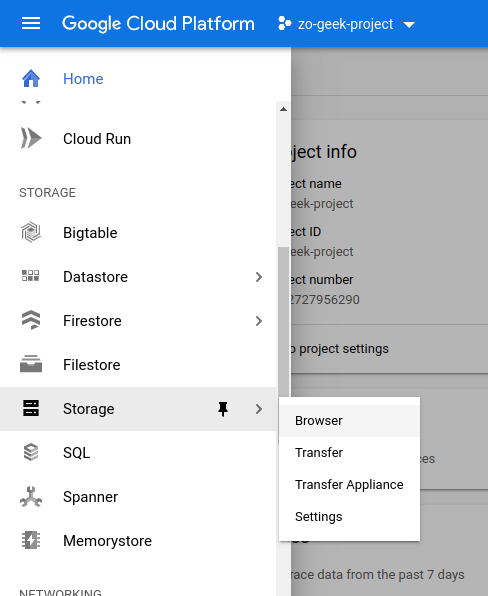
 

03. A list of existing Buckets will be shown if there are any. If empty, select the “Create bucket” button.


04. A step-by-step form will be shown where you have to enter the following details. The 1st section will ask to enter the Bucket Name.


Bucket Name Name of the bucket. Note this is a globally unique name. If another bucket with the name already exist, even if from a different account, it will be unavailable for use.

Example: zo-geek-bucket


05. Next is to select the Storage Class and Location.


Storage Class Options:

— Multi-Regional

— Regional

— Nearline

— Coldline

Regional if you want your data to reside within only the selected region in the “Location” selected.

Multi-Regional is used when your content needs to be accessed from multiple regions. Is more costly than “Regional”

Nearline are best used if the objects needed to be accessed like once a month. The storage cost for Nearline is less than Regional and Multi-Regional, but the retrieval price is more. Use this for data lakes and backups.

Coldline has the lowest storage cost but the highest access cost. Best used for storing archive like document retention and compliance.

Example: Regional

Location Depending on the “Storage Class” selected. The choices here are different. Select the location where the data will be accessed.

Example: asia-southeast1 (Singapore)


06. Next is to configure Access control model


07. The last section is Advanced Settings.

Encryption Options

— Google-managed key

— Customer-managed key

Data-at-rest at the Bucket are encrypted. If you want to select your own key, you can select “Customer-managed key” and choose from your own keys that have been added at the Cloud Key Management service. Choosing “Google-managed key” will let GCP create and manage the key.

Retention Policy Selecting the retention policy will set a duration on how long before the objects can be deleted. This provides protection from accidental deletion or modification after uploaded.
Labels Key-value pairs used for grouping related info. Can be used for filtering resources.


08. Review the details then select the “Create” button.


09. Once created, the view will look something like the following. You can then upload files and folders directly from the web console or use the SDK to perform programmatic interaction with the bucket. To get started with GCP SDK on Ubuntu view this guide.


Managing Lifecycle

Object lifecycle can be managed. This is useful if you want to keep archive or backups and want to do it automatically.


01. On the Buckets list. Select the Bucket that will be updated it’s Lifecycle.


02. On the bucket details, select the “Bucket Lock” tab. Then select “Add lifecycle rule” button.


03. You will need to specify the condition for the object and what actions will be done if the conditions are met.


CONDITIONS
Age Specifies the number of days the object has lived in the bucket.
Creation date All objects created on or before the specified date.
Storage class Depends on the storage class of the object.
Newer versions The number of versions the object has. Example, if “2” is specified, this means that if the object has been updated 2 times then it meets the condition.
Live state Options:

— Live

— Archived

Note that the term “Live” means that this is the active or latest version of the object.

ACTION Options:

— Set to Nearline

— Set to Coldline

— Delete

Changes the object storage class to “Nearline” or “Coldline” or even deletes the object. Sample use case is after “30” days change the storage class of the Object to Nearline. Then another is that when “Nearline” objects reached “60” days set the storage class to “Coldline”.


04. Confirm each section (Conditions and Actions), by selecting the “Continue” button. Then select the “Save” button on the bottom.


05. The Lifecycle rule for the bucket will now be updated.

Below is an example of rules assigned to the Bucket that sets the storage class from Regional to Nearline after 30 days, then after another 30 days to Coldline.

Read More  6 SAP Companies Driving Business Results With BigQuery

For enquiries, product placements, sponsorships, and collaborations, connect with us at [email protected]. We'd love to hear from you!

Our humans need coffee too! Your support is highly appreciated, thank you!

root

Related Topics
  • Bucket
  • GCP
  • Google Cloud
  • Objects
You May Also Like
View Post
  • Data
  • Platforms
  • Technology

Scaling cloud and AI: Microsoft Azure’s commitment to Europe’s digital future

  • May 11, 2026
View Post
  • Data
  • Platforms
  • Public Cloud

PayPal’s historically large data migration is the foundation for its gen AI innovation

  • March 4, 2026
View Post
  • Platforms
  • Technology

Microsoft Sovereign Cloud adds governance, productivity and support for large AI models securely running even when completely disconnected 

  • March 3, 2026
Google Cloud and Smart Communications
View Post
  • Platforms
  • Technology

Smart Communications, Inc. Dials into Google Cloud AI to Help Personalize Digital Services for Filipinos

  • October 25, 2024
View Post
  • Platforms
  • Public Cloud

Empowering builders with the new AWS Asia Pacific (Malaysia) Region

  • August 30, 2024
Red Hat and Globe Telecoms
View Post
  • Platforms
  • Technology

Globe Collaborates with Red Hat Open Innovation Labs to Modernize IT Infrastructure for Greater Agility and Scalability

  • August 19, 2024
Huawei Cloud Cairo Region Goes Live
View Post
  • Cloud-Native
  • Computing
  • Platforms

Huawei Cloud Goes Live in Egypt

  • May 24, 2024
Asteroid
View Post
  • Computing
  • Platforms
  • Technology

Asteroid Institute And Google Cloud Identify 27,500 New Asteroids, Revolutionizing Minor Planet Discovery With Cloud Technology

  • April 30, 2024

Stay Connected!
LATEST
  • digital-nomad-freelancer-worker-2151205464 1
    One paperwork problem – Get your Digital Nomad Visa employment documents fast from UK, EU or Singapore
    • June 16, 2026
  • 2
    Samsung Art Store Brings Art Basel to Homes Worldwide With New Curated Collection
    • June 15, 2026
  • 3
    You Do Not Need to Invest in the IPO of SpaceX, Anthropic, and OpenAI
    • June 10, 2026
  • 4
    The consequences of relying on AI for accurate news
    • June 10, 2026
  • 5
    Connecting AI agents with unstructured data using Google Cloud Storage MCP Servers
    • June 10, 2026
  • 6
    WWDC26: Apple unveils next generation of Apple Intelligence, Siri AI, powerful parental controls, and an expansive set of software improvements
    • June 8, 2026
  • 7
    IBM and Google Cloud Announce Strategic Partnership to Scale AI with Human Expertise and AI‑Powered Delivery
    • June 4, 2026
  • Data center 8
    Data Sovereignty in Spain. It’s Not Just About the Law, It’s About Efficiency
    • June 3, 2026
  • 9
    Ink vs Pixels. What you miss versus what you are actually missing.
    • June 1, 2026
  • 10
    Banks race to patch new cyber vulnerabilities, and other cybersecurity news
    • May 25, 2026
about
Hello World!

We are aster.cloud. We’re created by programmers for programmers.

Our site aims to provide guides, programming tips, reviews, and interesting materials for tech people and those who want to learn in general.

We would like to hear from you.

If you have any feedback, enquiries, or sponsorship request, kindly reach out to us at:

[email protected]
Most Popular
  • pope-leo-xiv-cq5dam-1500.844 1
    Pope Leo XIV to Publish First Encyclical on Artificial Intelligence and Human Dignity on 25 May
    • May 22, 2026
  • 2
    Portfolio to Clients, and is Strengthened by Ongoing Project Glasswing Work
    • May 20, 2026
  • reMarkable Paper Pure 3
    Everything The reMarkable Paper Pure Actually Does
    • May 14, 2026
  • 4
    Scaling cloud and AI: Microsoft Azure’s commitment to Europe’s digital future
    • May 11, 2026
  • Anthropic Institute 5
    Introducing The Anthropic Institute
    • March 11, 2026
  • /
  • Technology
  • Tools
  • About
  • Contact Us

Input your search keywords and press Enter.